
Author Archives: Karen Thomas Olsen

Genre: Prayer: For Whom? Gabe
My dear readers,
Today, I am supposed to address point two, Genre Identity, of our six points on The Reader-Navigator’s Map. Instead I’m going to ask for prayer. Yes, prayer is a genre, a category of communication both spoken and written. As a kind of literature, I can integrate it into our second point!
Prayer is a lifeline to the Lord. Like oxygen, we cannot live without it. Today, I want to ask you to pray for a 13 year old boy who is wasting away and will die without intervention — a miracle. This young man has dealt with neurological issues for years and has developed, probably from prescriptions, a disease called Akathisia, plus he has developed an eating disorder. Akathisia simply means” the inability to sit”; it is a movement disorder, an anxiety disorder. Combine this with an inability to eat or digest most foods, liquid or solid, and you can imagine the results. Continue reading
A Fleet of Books on my Biblical Literacy Shelf: Frigates 7-12
What a beautiful day today is! I’m sitting at my dining room table typing on my laptop while looking out over our side yard, viewing dwarf fruit trees in full foliage and tall rose bushes in prolific bloom — scarlet, yellow, and peach colored pedals. Billowy clouds herald God’s majesty.
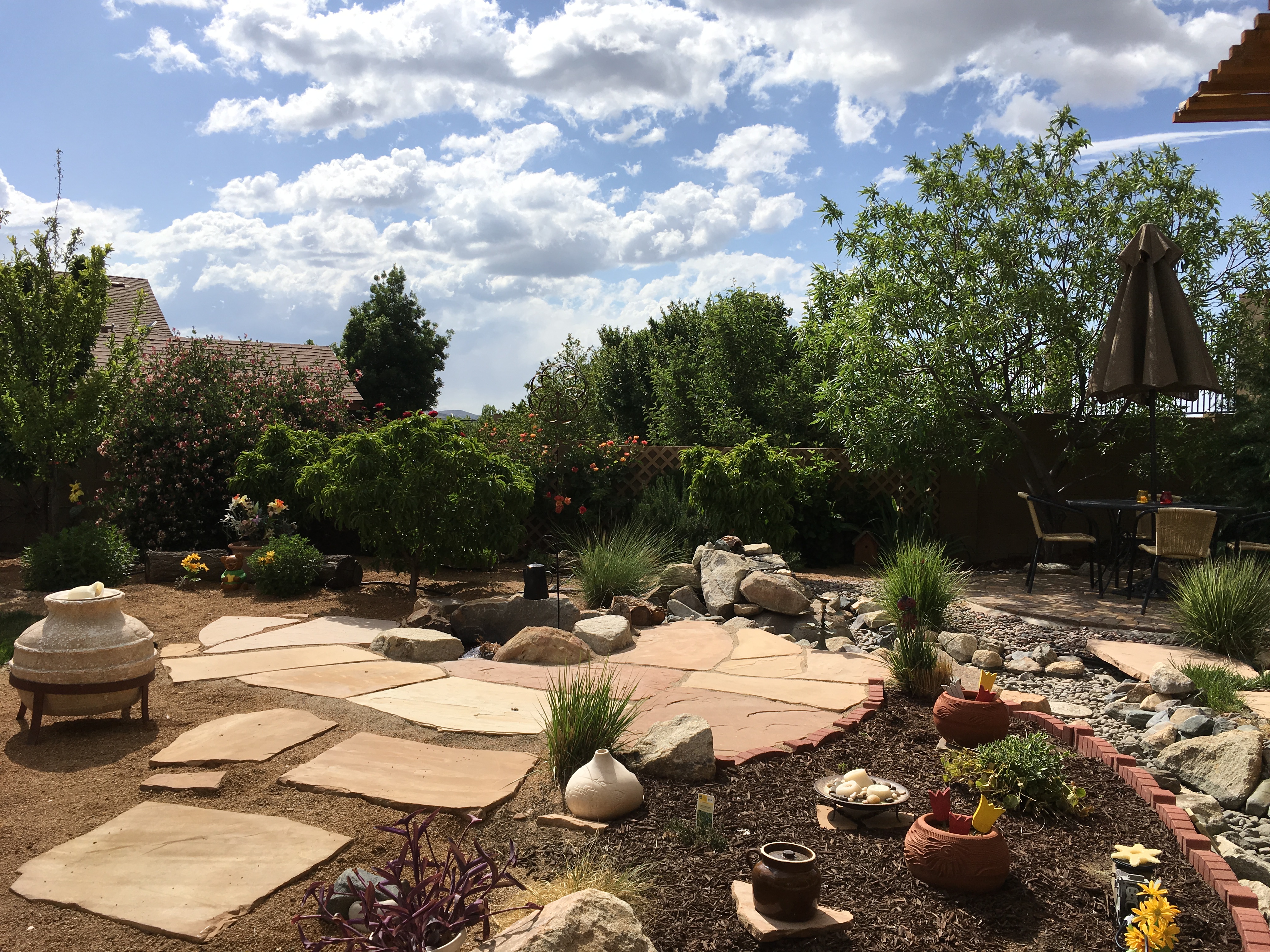
The heavens and our garden declare the glory of God.
Nature presents numberless volumes of divine literature: “The heavens are telling of the glory of God and the expanse is declaring the work of His hands. Day to day pours forth speech and night to night reveals knowledge “(Psalm 19:1-2 NASB). Telling, declaring, speaking, revealing. “God saw all that He had made, and behold, it was very good” (Genesis 1:31). From my window I’m reading a happy book. You have such books all around you in your nature’s libraries. Nature’s Divine Library.
In my previous post I presented suggestions for another library, your home library. I presented a dozen books as suggestions for your Biblical Literacy shelf, and then I described the first six. Today I’ll address the latter six books. Biblical Literacy (knowledge of Scripture’s narratives and declaratives; note post dated March 29, 2017) is the first of six points I’m offering as guidelines for navigating our reading experiences as Christ-followers — or pedestrian theologians — or salty, savory sailors on the Reading Sea. As Emily Dickinson declares, “There is no Frigate like a Book.”
Let’s look over the second six frigates, a small but powerful fleet. Ship Ahoy! (I hope you don’t mind my metaphors!) Continue reading
Your Home Library: One Dozen Books to Build Biblical Literacy
I always encourage young people to start their own, personal libraries — to begin with just one shelf in their bedrooms to place books worth keeping for a long time, some for even a lifetime. Whatever our ages are, we can equip ourselves with excellent resources to help us disciple ourselves in Christ and to guide us in whatever we read.
In our last post, I presented six points (guideposts, navigator’s criteria) to guide the Christian reader. You may wonder why my first point would be Biblical Literacy. Employing our ship/ocean metaphor that I set up in the last post, I am identifying Biblical Literacy as the anchor to ground us, the ballast to stabilize us, and the rudder to guide our vessels — as Christ-followers, thinking and interacting with what we read, whatever we may be reading. Therefore, I’d like to offer you a concise bibliography of core books to build your biblical base. You may have a number of these or some similar to them. You may find some here that you may want to add to your wish list. A person growing in biblical literacy and alert thinking will want to use books such as these. Continue reading
Categories: Christian Reader, Spiritual Growth
Tags: Bible Library, Bible study books, Biblical Literacy
2 Comments
A Good Friday to You
And what is good?
I have the next post in our series ready, but today is not the appropriate day for it. I awoke this morning, meditating on the meaning of good in Good Friday. You have probably heard much on this theme over the years, but we can never get enough nourishment.
My mind traversed various verses on this good theme. “The Lord is good; His lovingkindness is everlasting and His faithfulness to all generations.” “No one is good but God.” “You are good and do good.” “O, taste and see that He is good.”*
I thought of the first usages of the adjective, good, in the opening chapters of Genesis which describe God’s response to His own work: “And God saw that it was good”, repeated after each day’s work, but after the sixth day’s work, God saw that it was “very good”. God is good and does good work.** I thought of the Tree of the Knowledge of Good and Evil. I thought of pure goodness, as in God’s character and His work, in contrast to the more complex goodness expressed in a fallen world.
I thought of the cross as the ultimate expression of that good-bad goodness.
I’d like to present a few quotations, Continue reading
It’s Brief! – One Apology and Six Pithy Points for Readers
Why is it that one Christian describes a book as a blessing from the Lord, another finds it flawed but useful, and a third sees it as dangerous? Listening to differing views has motivated me to do some research and to write a basic list of guiding principles that can help us navigate our reading experiences (religious and secular) in ways that lead us away from the shoals and toward solid Christian growth.
I apologize for the tediously long, recent post that set up this new series! Let me redeem myself, as it were, with a brief post. Here is a preview of the six points (as currently standing) that we’ll be exploring in future posts. Please note that I’ve moved from a guidepost metaphor to a map/voyage metaphor.
Six sailing points on The Reader-Navigator’s Map:
- Biblical Literacy = both anchor and rudder 2. Genre Identity = the ship’s hull 3. Knowledge Soup = the ocean 4. Thinking Habits = wind in my sails 5. Influence and Influenced = Reader-Pilot’s changes/growth 6. Impact = From Pilot to other passengers — changes/growth
This is where this series is launched. This is where this post will dock! I’m excited to write about Genre (not gender) Identity! With these points, I hope you can anticipate where my reasoning is sailing.
God bless you with wisdom and joy in reading, remembering as Emily Dickinson expressed, “There is no Frigate like a Book. . . .”
Comments welcome! Invite a friend to join us!
Self-Discipleship in Christ through Reading*
R. C. Sproul recounts in his book, The Consequences of Ideas, the story of attending a parent conference in a public school when his eldest child entered first grade back in the 1960s.** Sproul listened to the principal explain the school’s philosophy and program, describing specific activities that promote particular aspects of child development. Every activity had purpose.
Finally, Sproul asked the principal, “What kind of child are you trying to produce and why?” The principal answered, “I don’t know. Nobody has ever asked me that question.”
Sproul replied, “I deeply appreciate your candor. . . but frankly, your answer terrifies me.”
The school’s methods stemmed from a purely pragmatic philosophy — what works; what succeeds. But succeeds at what? Pragmatism can foster a child who can do: read, write, compute, relate and respond. But what of the soul of the child? The composition of the heart? The character? The life? For what purposes is the doing?
This applies to our doing, and in this post, to our reading. “What kind of person am I aiming to become through my reading and why?” Continue reading
Standing on the Edge (with my books)
We always live at life’s edge. Each moment becomes that edge. Looking back often comforts me because I can avert my attention from the sharp brim facing the future. Every past moment is cushioned within the experiences before and after it. Its context is sure. I like that. The present pushes me away from the cushion. The sharp edge of the now connected to the handle of yesterday slices into the unknown, next moment. Yet, it is the mixed messages from yesterday’s record (the good and the bad) that make me nervous about the future. At first I wrote this as my next sentence: My comfort comes less from the past’s good experiences than from the God of those good experiences. Then I realized that this may be pious silliness.
Continue reading
How to Read and Beyond
I pulled three paper backs off the third shelf of our bookcase along the western wall in our living room at 2:00 a.m. this morning. Bodily discomforts of various sorts had awakened me. Sometimes I can return to sleep, but other times my body insists, “Forget sleeping!” My mind was immediately at work on a subject that has been toying with me for a number of days. Reading. What to read, how to read, when to read, and why read — all danced in my thoughts.
Quietly, I shuffled out to the living room, intent on not awakening my Paul. To the bookshelves. Taking the three volumes, I slumped in my leather, La-Z-Boy, covered myself with a blanket, took a colored pencil and a regular pencil, and opened the first book.
Jews and Christians are called “The People of the Book.” The Bible. We wear that label with great pride — both good pride and bad pride, I suppose. Books agitate. Continue reading
Categories: Spiritual Growth
Tags: How to read, Howard G. Hendricks, James W. Sire, Mortimer J. Adler
6 Comments
And Just What Is Government?
Paul and I spent most of Inauguration Day, Friday, January 20, following the events via our online connection which we cast to our “big” screen (a 37 inch flat screen that is not hooked up to use as a TV). Watching “the peaceful transfer of power,” our patriotic spirits were exercised, and we almost felt as if we were there. Almost! Happily, I was curled up in my roomy, warm, upholstered chair. The hubbub, the music, the crowds, the motorcades, the who’s who entrances — all blended to evoke a spirit of belonging — similar to (for me in my simpleness) going to a county fair, but on a huge and impactful scale. This is more than the satisfaction of belonging to a local community or club; on this day, we gratefully sensed our belonging to our country, the United States of America. ( Much of the week end’s madness had not yet happened. I choose not to smudge Friday’s memories with it.)
As I ruminated over the day’s events and words, I asked myself, “And just what is government?” The teens in my Sunday school class and I had discussed this a few weeks before when we were reviewing a period in ancient Israel’s past, the era of the judges, which preceded the kingdom era of King Saul, King David, and King Solomon. In the era of the judges, everyone did what was right in his own eyes (Judges 17:6). I asked my teens, “What is government?” Their only association of the word is with politics — some form of civil government and economic system such as democracy or communism. Hmm. There is something important beneath these ideas, something preceding them.
 Journey North Character