Perspectives on Culture

From Longing to Longing: Richard and the Crude Russian Officer

Today, I’m going to tell a fascinating story which will take us back to the series my last post interrupted .

The series I interrupted was about atheism, secularism, religion, and education, in response to some questions from a reader. Rather heavy, I suppose. So, in my previous post I lightened the reading up by telling  you a heartwarming story from my own experience recently in which I spent three days with two friends from high school, our memories reaching back many decades.  I hope you enjoyed the account and photos.

Today’s true story reaches back to World War II (yes, before my time!). I referred to this incident in my post on September 14. I have included this story in chapter 11 of my unpublished Bible study, A Traveler’s Guide through Suffering and Joy. This is the story of  “Richard and The Crude Russian Officer”.

Last week I took this photo a few blocks from our home. The trees are changing color earlier this year.  I wonder, “What time of year did the Russian officer meet Richard?” I don’t know, but the meeting brought more color into the lives of each man, and mine too, just by reading the story.
Continue reading

Categories: Dr. A.A. Hodge, Education, Government, Joy & Suffering -- Good & Evil, Perspectives on Culture | Tags: , , | Leave a comment

Provoking More Thought While Harvesting Some Produce

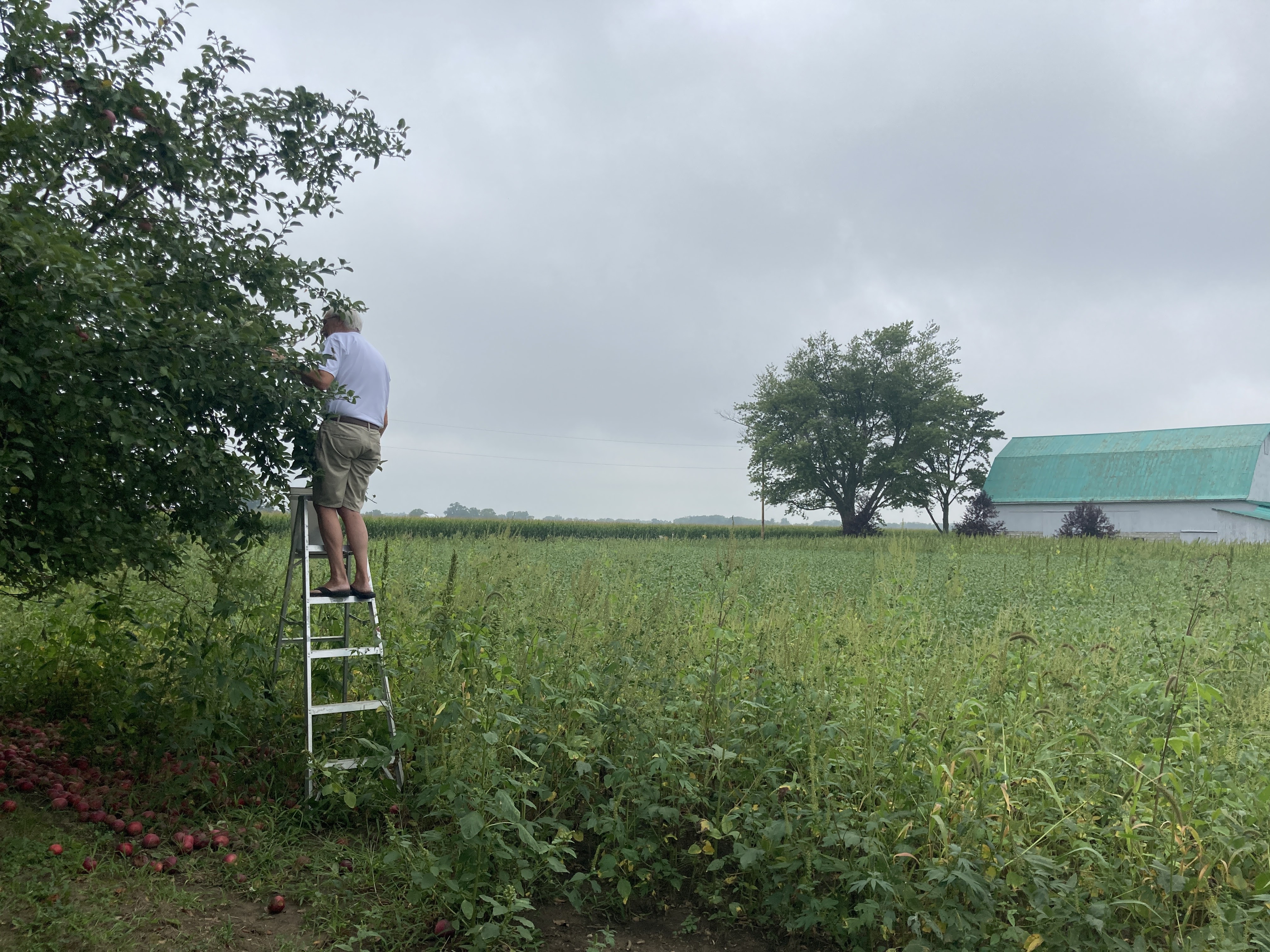
In this post, I will continue my response to Amanda O and incorporate some photos from a recent trip we took to Aunt Mary’s farm (the Findlay Family Farm, as I call it, where my mother was born and reared). I’ll address the following portion of  Amanda’s thought-provoking, recent comments:

Regarding Mr. Hodge’s claim “the United States’ system of national popular education will be the most efficient and wide instrument for the propagation of atheism which the world has ever seen”, I doubt this. Atheism is very rare in our country and, as best as I can tell, it is very unnatural. Most people want a transcendent explanation of our world. I haven’t looked it up, but I would bet Atheism is very rare globally for exactly this reason. Instead, I think Mr. Hodge’s statement would be far more potentially accurate if he simply substituted the word “secularism” for “atheism”.

When I first read Dr. Hodge’s statement, and then in its context, I wondered the same thing. Would “secularism” be a better term for him to employ? With further reading and thought, I realized, not so. Changing the word “atheism” to “secularism” would not accurately clarify his thought.

Paul, picking apples at the Findlay Family Farm last week.

Why? First, in this context, it would be redundant or circular. Earlier in your comment (note previous post) you had quoted more of Dr. Hodge’s statement: “I am … sure … that a comprehensive and centralized system of national education, separated from religion… will prove the most appalling enginery for the propagation of … atheistic unbelief.” 

Dr. Hodge’s description of public education as “separated from religion” concisely defines secularism: to separate from religion is to secularize. His point was not to say that secularism will produce more secularism.

He meant that secularism leads to atheism — especially when it is made into a comprehensive, nationally centralized system of education.

The question then arises, is this so?

Continue reading

Categories: Dr. A.A. Hodge, Education, Grandparenting, Parenting, Perspectives on Culture | Tags: , , , | 2 Comments

Thought-Provoking Thoughts that Provoke Thoughts About Secularism, Schools, and Christianity

Over a week ago, I received a probing response to my June 8 post, “From Trans to Trans: Getting Involved in the Transformative Activity of the Gospel.” This kind of response in the comment section of the blog requires an entire post or series of posts in reply. So, please read Amanda O’s thought-provoking contribution below. You may need to read or re-read my June 8 post before reading the rest of this post. I’ll break down my response to Amanda in a series that I’ll publish closer together in the next weeks, so you can follow the conversation without being overwhelmed.

From Amanda O:

This is thought-provoking.

Continue reading

Categories: Education, Grandparenting, Parenting, Perspectives on Culture | Tags: , , , , | 2 Comments

#4: “Only the Informed Can Act” Really? What if…

Amazing. I am overwhelmed at all the ideas and information I encounter daily. You know I spend a fair amount of time reading. And I listen to some podcasts. I also listen to some news on various outlets. But reading is my main avenue of information.

Here are some of the books I’m in the middle of reading:

Yesterday, I was reading The Origins of Sectarian Protestantism, subtitled ” A Study of the Anabaptist View of the Church.” My religious heritage is the Brethren, originating in 1708 in Schwarzenau, Germany. The Brethren were influenced by the Roman Catholic, Reformed (Lutheran and Presbyterian), Anabaptist, and Radical Pietist elements of the universal church. So, I pulled out my two volume Brethren Encyclopedia and spent hours in them reading.


I inherited The Brethren Encyclopedia from my father, the author of that poem, “Suppose” (included in my post from May).  I was amazed at what I found inside these books. No, I should not have been surprised. What I found was just what I should have expected. My dad added lots of highlighting, commentary, photographs, and articles.

In his retirement years, besides writing sermons and poetry, my dad wrote letters to elected officials and submitted many “letters to the editor” of the local newspaper which were printed in the Findlay Courier (Findlay, Ohio). He wrote these letters for the editorial page for years, and we heard about them (mostly positive responses) from family and friends. I’ve often wished that we had paid more attention to this. We were busy living our own lives, and I don’t remember reading dad’s submissions. I found a number of them taped inside the encyclopedia volumes. I want to share one of them with you today that fits perfectly with my current JNC series. Dated March 30, 1984, it is entitled “Bible Reading Needed For Freedom.”

Continue reading

Categories: Education, Grandparenting, Parenting, Perspectives on Culture | Tags: , , , | 4 Comments

#3: From Trans to Trans: Getting Involved in the Transformative Activity of the Gospel

In the midst of the messy times in which we live, I have so much encouragement to pass on to you today! Let the exclamation point communicate anticipation and excitement!

(Confident in their Creator, these tall irises transform our front yard.)

.

This is the third in a series dealing with certain, current social issues and some needed, biblical responses. I began with a contrast between the trans movement of today and the ancient, biblical trans movement of Christ-transformation. Then, through my father’s poem, “Suppose,” we considered what life would be like if Jesus had never entered human history, observing that the world in which our children live today is rather like that “suppose He never came” world. For many, such supposing is so. Sigh.

But Christ did come, fulfilling Old Testaments promises and bringing us hope.

I concluded the previous post by reminding us of Jesus’ proclamation in the synagogue at the beginning of His ministry when He read aloud from the Isaiah scroll:

The Spirit of the LORD is upon Me because He anointed Me to preach the Gospel to the poor.

He has sent Me to proclaim release to the captives, and recovery of sight to the blind,

to set free those who are downtrodden, to proclaim the favorable year of the Lord.”

Luke 4:18-19

Closing the scroll, with all eyes fixed on him, Jesus explained:

 “Today this Scripture has been fulfilled in your hearing” (verse 21).

 I concluded:

“Today. Today is the worst of times; today is the best of times. Today is the “favorable year of the Lord.”

Let us seek Him.”

In this worst-best of times, I ask in today’s post, how can we help hurting people find Him who is seeking them?

Continue reading

Categories: Dr. A.A. Hodge, Education, Grandparenting, Parenting, Perspectives on Culture | Tags: , , , , | 8 Comments

#2: Suppose

I’ve never done this before, but it’s time.  For twelve years I’ve written all the articles for this blog, Journey North Character. I’ve never re-posted an article, but I am today, adding a bit at the opening and closing to connect it to our new series. I’ll also add a photo.

Last month I began a new series dealing with some current social issues and biblical responses, by juxtaposing the trans movement with transformation in Christ. Now there’s a contrast.

I published the following post on June 22, 2014, entitling it “The Rest of Dad’s Poem.” Paul and I lived in Prescott Valley, Arizona then. Sigh (memories).

***

I’ve been sitting on my recliner, reading my father’s poetry and his grandfather’s poetry. My dad — Marion R. Thomas. My great-grandfather — Daniel Driver Thomas. I never met Daniel Driver, but I heard about him from my father. Dad loved and respected his family members. Dad loved and enjoyed God’s world.

Marion Thomas, age 81. Picture taken by his oldest grandchild, Amanda, when she was taking a photography class at our community college. Note the knit cap he often wore in his latter years when he was cold.

I even found a poem he wrote entitled, ” Come, Celebrate Grass” ( 40 lines about his lawn, written around 1987).  [Another poem he wrote, which I think will connect well with our new series on current social issues, is Dad’s poem entitled “Suppose” written in the 1940’s when Dad was in his 20s.] Here it is. Continue reading

Categories: Education, Parenting, Perspectives on Culture, Spiritual Growth | Tags: , | 6 Comments

#1: Isaiah, Jesus, and Whatevermike

I read. I listen. I compare. Hmm. What are the meanings of their messages? Can one discern?

Whose messages?

Isaiah, the Prophet, as he “hears the word of the Lord,” Jesus, the Christ, as He hears the word of the Lord through Isaiah, and Whatevermike, as he hears the word and anti-words of another god.

Ahh. I have distinguished already differing deities. If the messages are from the one and same “god,” then we will interpret the meaning and consider applications differently than we would if the messages are sourced in separate “gods.”

Where is this world headed? Who is at the helm?

I am currently reading the book of Isaiah. During the season leading up to Resurrection Sunday, I was nourished by the New Testament gospels. Isaiah lived probably 700 years before Christ. His writings, ancient to the Son of Man (but not to the I AM of John 8:58), present Christ’s calling card:

“The Spirit of the Sovereign LORD is on me, because the LORD has anointed me to preach good news to the poor. He has sent me to bind up the brokenhearted, to proclaim freedom for the captives and release from darkness for the prisoners, to proclaim the year of the LORD’s favor” (Isaiah 61:1-2a; compare to Luke 4:19-20).

How privileged we are to have the Scriptures, to be able to read them and hear them taught. I have not been sheltered from the Bible. God’s Word has not been canceled from my sight or hearing. But the Word has been sidelined in our society, as you well know.  In the public square it has been ridiculed, maligned, disdained, and largely rejected. Yet, its voice is not extinguished. Like invisible sound waves, its truths penetrate, rumbling beneath our feet.

What is the spirit of this age? Whose spirit is upon whom?

Continue reading

Categories: Education, Parenting, Perspectives on Culture, Spiritual Growth | Tags: , | 4 Comments

How are People Nurtured — In Our Constitutional Republic and Pluralist Society?

Today, I will confront the last two of four question-points in this current series (which interrupted another series). These are the questions I’ve been addressing in answer to a reader’s inquiry about an extended quotation I presented by Dr. A.A. Hodge regarding  the impact he foresaw  back in 1887  that secular, public education would have on America.

“In God We Trust.” Where have I read these words?

The previous two posts considered the first two points listed below. Now, let’s consider the latter two.

  1. What is pluralism and what is a pluralistic society?
  2. According to the U.S. Constitution, what is the role of government in education? What/who is responsible for education?
  3.  In our Constitutional Republic, how are individuals nurtured, and how is our culture nurtured?
  4.  What are the roles of the Bible and a “Judeo-Christian” heritage in our current “pluralistic society”?

Nurtured. Nurturing individuals. Nurturing cultures. What is nurture? What does a country’s form of government have to do with the nurturing of individuals and cultures?

Of course, I can’t fully answer these questions, but I can present some ideas pertinent to our times for you to ponder.

Continue reading

Categories: Christian Reader, Dr. A.A. Hodge, Education, Government, Perspectives on Culture | Leave a comment

How Can Christianity and Education Dance Together in a Pluralistic Society?

Do you remember the post from last fall in which I included this quotation by Dr. A.A. Hodge, first published in 1887?

“I am as sure as I am of the fact of Christ’s reign that a comprehensive and centralized system of national education, separated from religion, as is now commonly proposed, will prove the most appalling enginery for the propagation of anti-Christian and atheistic unbelief, and of anti-social nihilistic ethics, individual, social, and political, which this sin-rent world has ever seen.”

Irises pleasantly sway in our front lawn. “Consider the…irises.” (I have no lilies blooming now to consider.)

It is capable of exact demonstration that if every party in the States has the right of excluding from the public schools whatever he does not believe to be true, then he that believes most must give way to him that believes least, and then he that believes least must give way to him that believes absolutely nothing, no matter in how small a minority the atheists or the agnostics may be. It is self-evident that on this scheme, if it is consistently and persistently carried out in all parts of the country, the United States’ system of national popular education will be the most efficient and wide instrument for the propagation of atheism which the world has ever seen.”

A reader inquired:

“Regarding the quote from Dr. A. A. Hodge, “I am as sure as I am of the fact of Christ’s reign that a comprehensive and centralized system of national education, separated from religion…”, what religion might he be referring to? Or perhaps to any religion or a group of religions? If he meant a particular religion, and if that particular religion was Christianity, I would love to hear your understanding of how Dr. Hodge says this works in a pluralistic society. And, if it doesn’t work in a pluralistic society from his perspective, does he advocate theocracy?

I responded with a long response (for the comment section), and the reader responded again:

“I currently struggle to see how his ideas are actionable let alone defensible in a pluralistic society so I really look forward to hearing this unpacked and learning where I may be misunderstanding things (which may simply be a term or two!).”

So today, I’ll do some unpacking.

Continue reading

Categories: Christian Reader, Dr. A.A. Hodge, Education, Government, Perspectives on Culture, The Roaming Reader | Tags: , , , , | 2 Comments

Back to Kirk (The Roaming Reader: 3)

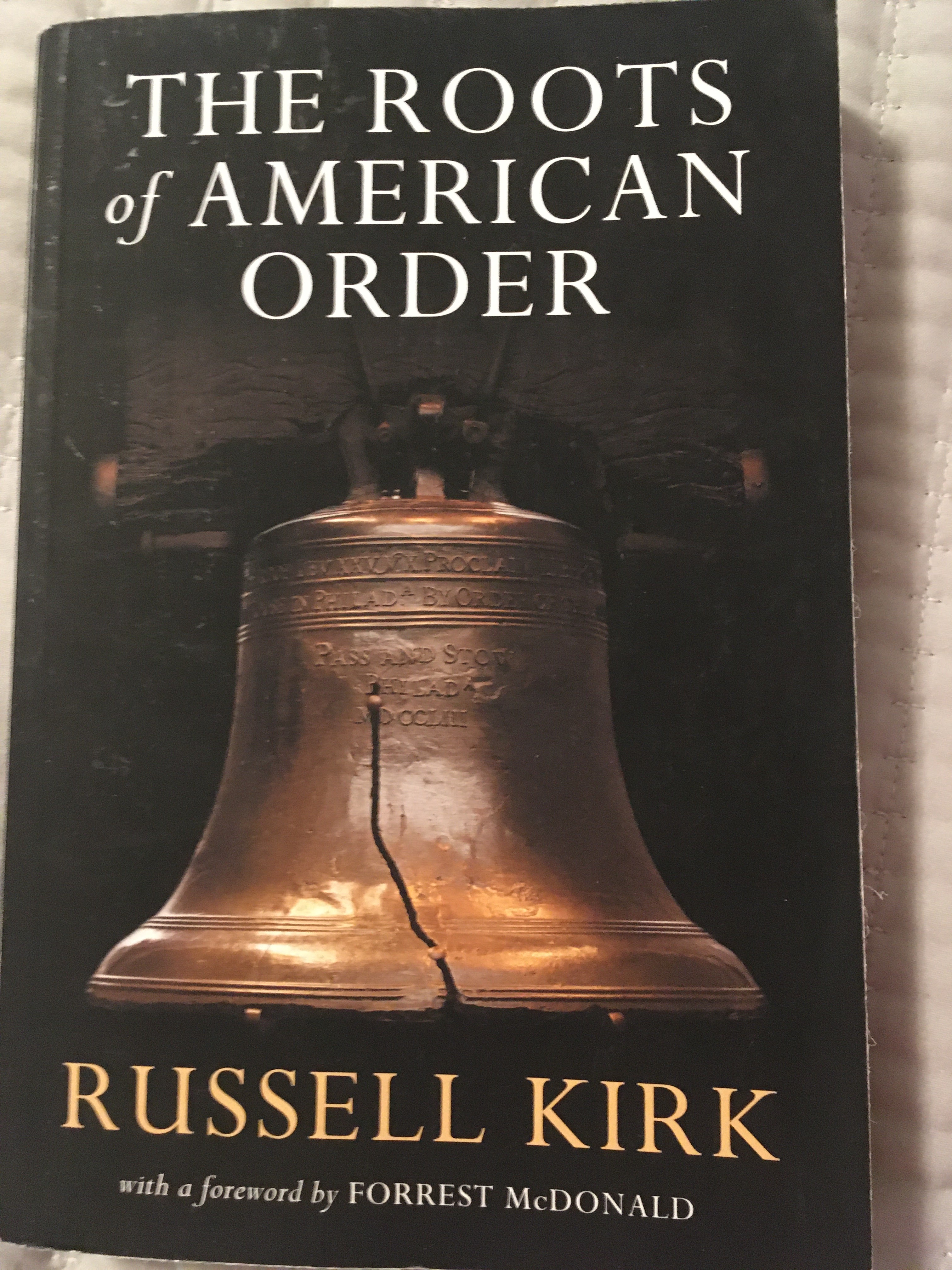
Back to Kirk! I’m still focused on the first book of the list I gave you in March: The Roots of American Order, by Russell Kirk. (We noted Kirk’s definition and description of “order” in the last post.)

Worth reading.

In the short, first chapter, “Order, the First Need of All”, Kirk tells the story of a scholar born in Russia. He had been a moderate Socialist in 1917, a Menshevik. He fled to Odessa on the Black Sea, but what did he find there? “Bands of young men commandeered street-cars and clattered wildly through the heart of Odessa, firing with rifles at any pedestrian, as though they were hunting pigeons. At any moment, one’s apartment might be invaded by a casual criminal or fanatic, murdering for the sake of a loaf of bread. In this anarchy, justice and freedom were only words.”

So what did this scholar learn?

“Then I learned that before we can know justice and freedom, we must have order. Much though I hated the Communists, I saw then that even the grim order of Communism is better than no order at all. Many might survive under Communism; no one could survive in general disorder.”

Kirk contrasts this story to our American experience. “In America, order and justice and freedom have developed together; but they can decay in parallel fashion.”

While this volume was published in 1974 and reflects the thought and writings of Kirk since the early 1950s, we clearly see its relevance for today. Such is the nature of wisdom.

I lost myself in this book.

Cups of tea encourage me as I read and write. Thankfully, spring is peeking in the windows. Next week is supposed to be warm and sunny here in Indiana!

Continue reading

Categories: Christian Reader, Government, Perspectives on Culture, The Roaming Reader | Tags: , , | 5 Comments

Blog at WordPress.com.