
In this post, I will continue my response to Amanda O and incorporate some photos from a recent trip we took to Aunt Mary’s farm (the Findlay Family Farm, as I call it, where my mother was born and reared). I’ll address the following portion of Amanda’s thought-provoking, recent comments:
Regarding Mr. Hodge’s claim “the United States’ system of national popular education will be the most efficient and wide instrument for the propagation of atheism which the world has ever seen”, I doubt this. Atheism is very rare in our country and, as best as I can tell, it is very unnatural. Most people want a transcendent explanation of our world. I haven’t looked it up, but I would bet Atheism is very rare globally for exactly this reason. Instead, I think Mr. Hodge’s statement would be far more potentially accurate if he simply substituted the word “secularism” for “atheism”.
When I first read Dr. Hodge’s statement, and then in its context, I wondered the same thing. Would “secularism” be a better term for him to employ? With further reading and thought, I realized, not so. Changing the word “atheism” to “secularism” would not accurately clarify his thought.
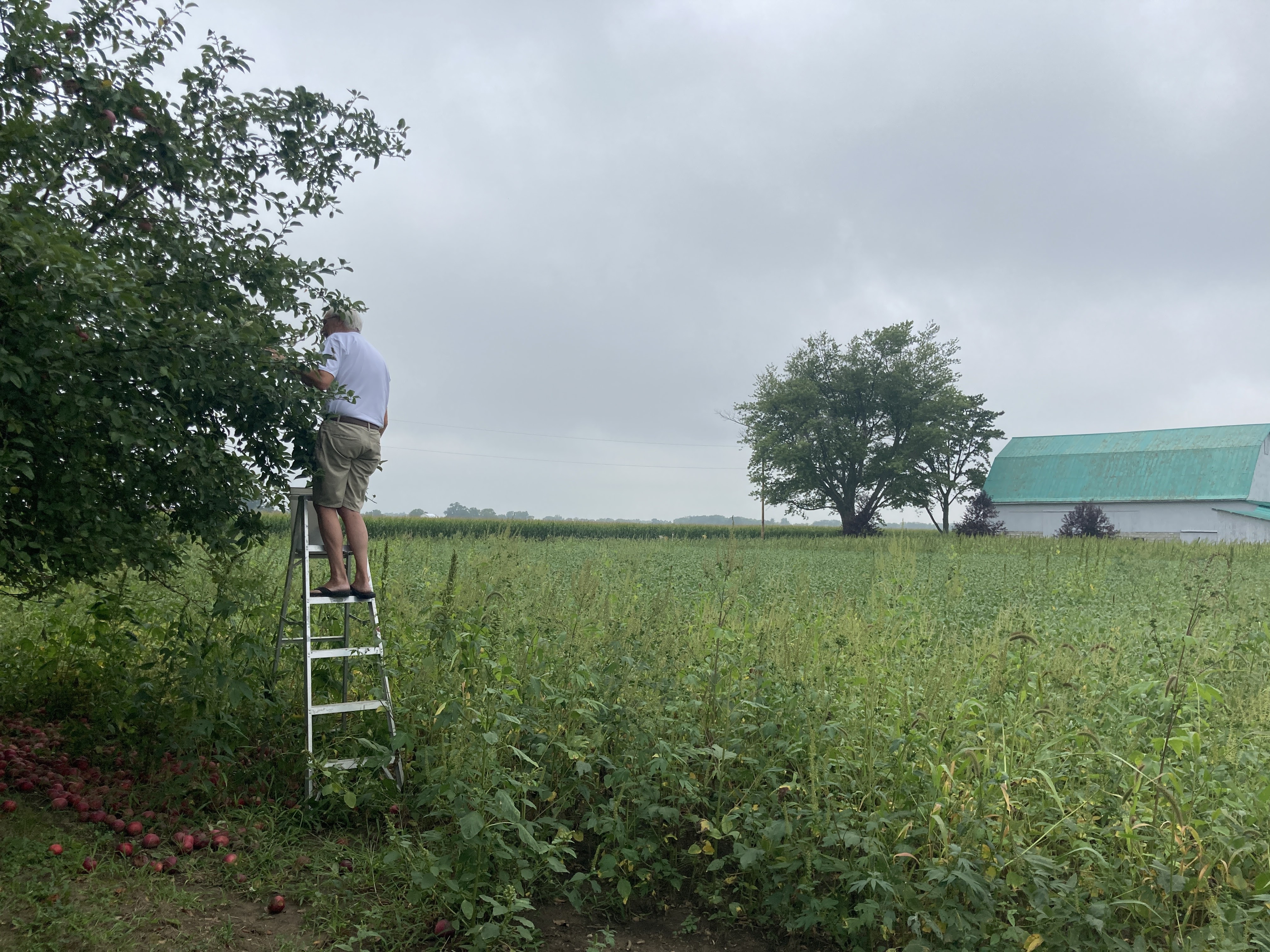
Paul, picking apples at the Findlay Family Farm last week.
Why? First, in this context, it would be redundant or circular. Earlier in your comment (note previous post) you had quoted more of Dr. Hodge’s statement: “I am … sure … that a comprehensive and centralized system of national education, separated from religion… will prove the most appalling enginery for the propagation of … atheistic unbelief.”
Dr. Hodge’s description of public education as “separated from religion” concisely defines secularism: to separate from religion is to secularize. His point was not to say that secularism will produce more secularism.
He meant that secularism leads to atheism — especially when it is made into a comprehensive, nationally centralized system of education.
The question then arises, is this so?
Does comprehensive, educational secularism lead to atheism? More questions follow: Is there more we need to know about secularism? Atheism? Could secular education lead to other results than atheism? Is atheism really unnatural and rare, as you conjecture? Does a “transcendent explanation of our world” (your wording) hold enough theistic substance to carry meaningful weight?
These are more questions than we can entertain well today, but let’s take a stab at a few of them.
Let’s begin with, “Is there more we need to know about secularism and atheism?”
The Religion Blog from the University of Groningen posted an article by Terrell Carver, a professor of political science from the University of Bristol (posted Nov. 2012). He addresses the question, “Where is the line between atheism and secularism?” Jumping into the middle of the article, I offer you a quotation from the professor:
“Atheism is not about the persecution of believers, neither is secularism about the destruction of religion. Atheism is itself a belief system, whereas secularism is a political doctrine. As a doctrine it is supposed to ensure that all perspectives on belief and non-belief can be freely expressed in public life, and indeed that the state is not actively promoting one belief, rather than another, or indeed none at all. Similarly, it is supposed to ensure that state requirements and regulations do not interfere unduly with religious practices and ‘the free exercise thereof’, and indeed that states recognize that religion has a place in public life over and above its importance in a realm of ‘private’ conscience and belief.” #1
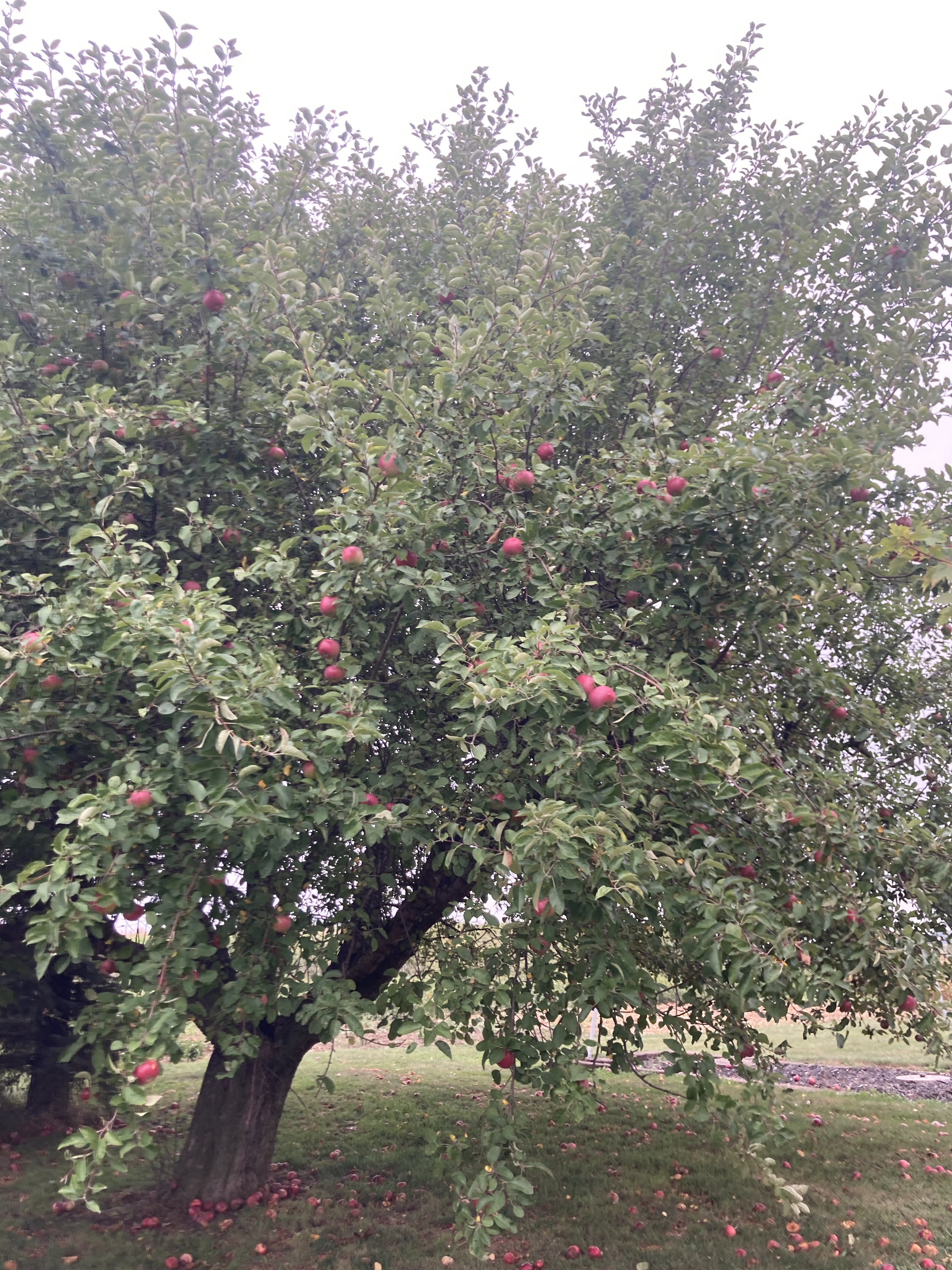
Aunt Mary’s apple tree produces five kinds of apples! Yes, five kinds were grafted into one tree and the tree was planted in her side yard over 30 years ago. As you can see, it needs a good hair cut, but it is happily producing delicious, organic apples. Yes, organic: the tree has not been sprayed.
Interesting. He presents atheism as a belief system (worldview), but secularism as a political doctrine. What is a doctrine? Is it not a claim (a teaching) that is a belief, so is it not also a worldview? As a political doctrine-claim-worldview, it is a social-political method or strategy of implementation and operation of that doctrine. It is a way of organizing the puzzle pieces of what is considered secular and what is considered religious. These pieces go here; those go there. Does it “ensure that all perspectives on belief and non-belief can be freely expressed in public life”? How does this work out? No persecution kicks in at some point? No religious destruction? He offers some topics you can use to evaluate how this political doctrine works in real life in our country. If you are interested, access the entire article in the footnotes below (#1).
Here is a paragraph from Ligonier Ministry (the ministry of the late R.C. Sproul) from March 29, 2023:
“What are atheism and secularism?”
“Atheism and secularism are two widely influential modern philosophical worldviews. Though not organized religions, these two philosophical worldviews are inherently anti-religious. Proponents of atheism reject theism and religion. Proponents of secularism reject the presence of theism and religion in political and societal institutions. All atheists profess to be secularists; however, not all secularists profess to be atheists. An estimated 250 to 500 million people worldwide do not profess belief in any deity. This includes two hundred million to four hundred million residents of countries such as Russia and China, as well as thirty million residents of the United States.”#2
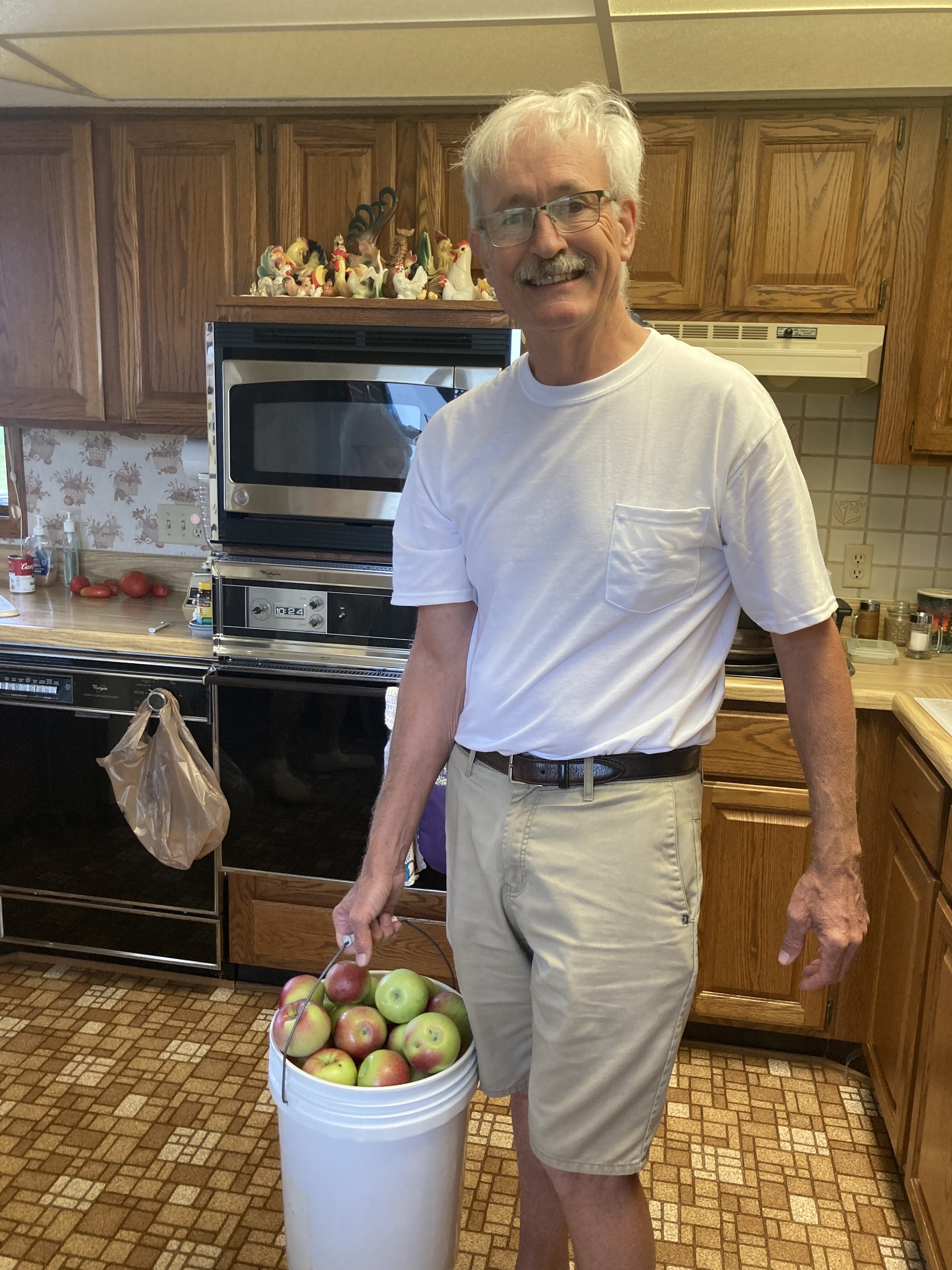
Paul brought in four big buckets and will be going back in a few days to pick more.
Interesting. This article by the editorial board of Ligonier states that “all atheists profess to be secularists, ” but the opposite is not true. You can access this article below (#2). Are the 250 to 500 million people who “do not profess belief in any deity” atheists? Certainly, many of them, some would say that all of them are atheists. My Oxford English and my original Webster’s dictionaries state that an atheist is one who “denies” or “disbelieves” in the existence of any deity.
I believe that many who do not profess belief want to believe in God. The god-longing is deep within us (or as you put it, a wanting of “a transcendent explanation of our world”), though the longing can be suppressed, re-routed, or denied. In his book, Tortured for Christ which has become a classic, Richard Wurmbrand tells his painfully beautiful story of meeting a Russian officer who has lived his entire life believing in unbelief as he was taught– the material world is all there is. Wurmbrand reads the Sermon on the Mount, the parables of Jesus, and the narrative of Christ’s life to the man. The officer’s response is astounding…. It is a crying shame, a horror, that so many people have been denied a clear knowledge of the New Testament, or that Bible reading has been so denigrated. I hope to tell more of this story in another post, if you would like to hear it.
The New Atheist movement that has grown the last nearly twenty years seems to be reshaping itself. I would not say that atheism is rare in our country, but it is not huge, yet its voices are louder than its numbers. I’m sure you remember the atheists who have been dubbed “The Four Horsemen”: Richard Dawkins, Sam Harris, Christopher Hitchens (1949-2011), and Daniel Dennet. I find it so ironic that a biblical term/title is employed to describe them, a title they either approved or chose for themselves. In September 2007 a two hour video recording of their conversation was made entitled The Four Horsemen, which is available on Richard Dawkins’ website.
I am very cautious with Wikipedia, but it has a helpful article about “secularization.” (One of the best things about Wikipedia is the citations at the end of articles which can provide places to continue your research.) The article states:
“Secularization, in the main, sociological meaning of the term, involves the historical process in which religion declines in social and cultural significance. As a result of secularization the role of religion in modern societies becomes restricted. In secularized societies faith lacks cultural authority, and religious organizations have little social power.” Hmm. So much could be unpacked here. A process. Declines in significance. Restricted. Lack of cultural authority and social power (influence).
I then checked out the organization, the Freedom From Religion Foundation, Inc. (FFRF), which explains its purposes this way:
“The purposes of the Freedom From Religion Foundation, Inc., as stated in its bylaws, are to promote the constitutional principle of separation of state and church, and to educate the public on matters relating to nontheism.”
Note that FFRF neatly aligns secularism with atheism. It defines secularism as “the constitutional principle of separation of state and church” and its educational goal is to promote “nontheism.” What is the difference between nontheism and atheism? Nothing, except the former may offer a softer connotative impact. “Non” and “a” are two prefixes communicating a negation (“a- = un-, non-“, notes the OED). You may ask, what does the FFRF have to do with secular, public education? The influence of various foundations upon teacher training institutions, teachers’ unions, curriculum development, and state standards would be another avenue of exploration. But here, the issue is raised as a point of concern.
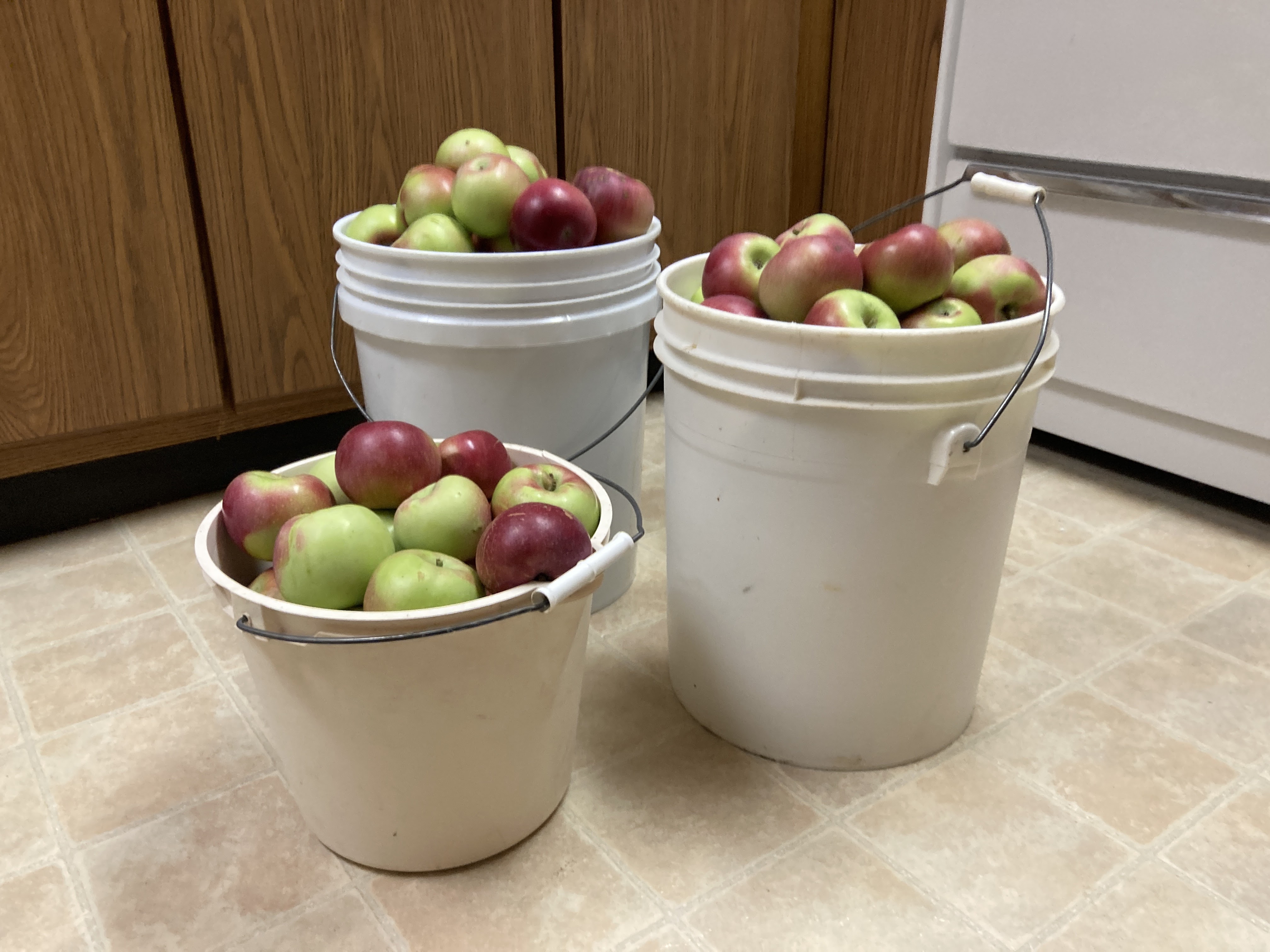
Three of the four buckets of apples Paul picked. He placed them in Aunt Mary’s basement kitchen where she and one of her nieces (one of my cousins) will make applesauce and freeze much of it. For generations family members have canned and processed produce in the basement kitchens of their farm houses.

Before air conditioning, a second kitchen located in the basement meant so much. It also freed up the main kitchen for regular meal preparation. Even off the farm, my mother, a pastor’s wife, had a basement kitchen during most of her married life for such purposes and was so grateful for it. Paul brought home a bucket of apples for us to enjoy: fried apple-oats, apple crisp, apple slices, frozen apples for pies for the holidays…! (However, we have do not have a basement.)
So, where am I headed with all of this? We see that while secularism and atheism are not the same, they do have a serious relationship. I observe that to secularize — to separate out religion and its point of views from the rest of reality, calling the rest the “secular”– is a mind-changing (worldview shaping) tactic to make religion appear at first as irrelevant, and then temptingly in time as not real — “non”. I can live without God. We can flourish without God. God? From where does this voice come?
Some may argue that this secularizing tactic could do just the opposite. Instead of making religion appear irrelevant, to some, it could appear even more relevant, truly sacred, possibly an unintended consequence from the truly (militant) atheistic perspective. And this is an angle that we should explore — in another post and in life.
I place The Gospels (and the Bible) and “religion” in the same camp (although there are of course other religions). Many evangelicals say faith or true Christianity is not a religion but a relationship. Poppycock. This is an unreasonable either/or option. Faith or true Christianity is both. My faith as a Christian and yours is a relationship with God through Christ in which God reaches out to us — while we were yet sinners, Christ died for us (Romans 5:8 and the entire chapter and book!). Our faith is part of a religion, the religion of Christianity.
“Religion” from the Latin religio/religo = re as in anew and ligo meaning to bind = to bind anew, a sacred vow; a bond. Noah Webster’s first definition provides much to consider: “Religion, in its most comprehensive sense includes a belief in the being and perfections of God, in the revelation of his will to man, in man’s obligation to obey his commands, in a state of reward and punishment, and in man’s accountableness to God; and also true godliness or piety of life, with the practice of all moral duties. It therefore comprehends theology, as well as practical piety; for the practice of moral duties without a belief in a divine lawgiver, and without reference to his will or commands, is not religion.”
I do not live up to this definition of religion, but it is my desire and pursuit. True Christianity, as I see it, is both a relationship and a religion.
Underneath the cover picture of the video, The Four Horsemen of atheism, is this sentence: “All four authors have recently received a large amount of media attention for their writings against religion….” Against religion. They are against true Christianity (as well as other religions) and have been called “evangelical atheists.” I am against atheism because it is against God.
I am against an unrestrained secularism, because it deceives people into thinking that they can live without a relationship with God and without religion to shape meaningful lives, for this life and the life to come. Unrestrained secularism — comprehensive, nationwide, from childhood through adulthood, throughout the public square, throughout one’s career — such segregation of religion from lived-life seduces people into delusional visions of self-autonomy and humanistic optimism (idolatry). Since the fruits are dangerous, we need to refuse to be intimidated and silent. Silence is not loving, but what are loving responses in words and deeds? Thought-provoking.
In closing for today, I do think that Dr. Hodge’s prediction (published way back in 1887) regarding comprehensive secularism leading to pervasive atheism follows a logical trajectory. Nonetheless, I see (136 years later) that his aim was off a degree. Not bad predicting. So sad living it. We will continue in the next post.

While Paul picked apples, 92 year old Aunt Mary worked in her main floor kitchen, making stuffed peppers using peppers from her large garden for our supper that night.

I have never like stuffed peppers. However, I took lessons from Aunt Mary and really liked her version! I’ll try it at home sometime.

Wow! On our way home from the Findlay Family Farm ( a one and a half hour drive) that very night! Thankfully, nothing naughty burst from this intimidating sky.
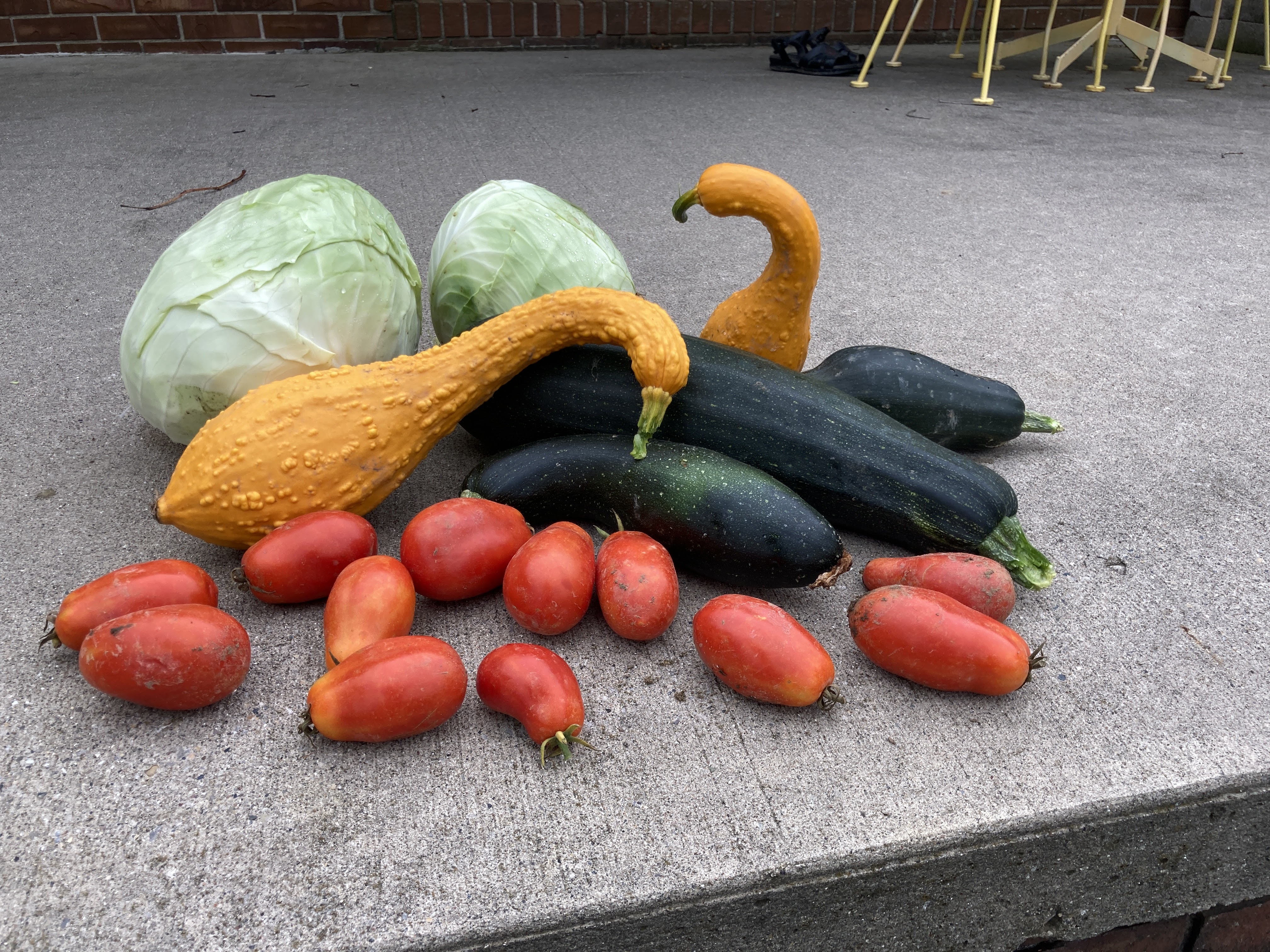
Most of Aunt Mary’s garden produce has been harvested. Going through her garden, I found these, ready to be picked. Boy, that big zucchini should have been picked days ago! Yet, it all is so beautiful.
Then Jesus said to His disciples,
“The harvest is plentiful, but the workers are few.
Therefore, beseech the Lord of the harvest
to send out workers into His harvest.”
Matthew 9:37-38
lang=en#:~:text=Atheism%20is%20itself%20a%20belief,secularism%20is%20a%20political%20doctrine.
#2. https://www.ligonier.org/learn/articles/field-guide-on-false-teaching-atheism-secularism
Discover more from Journey North Character
Subscribe to get the latest posts sent to your email.

 Journey North Character
Love this – “The harvest is plentiful, but the workers are few. Therefore, beseech the Lord of the harvest to send out workers into His harvest.”
Thank you, dear faithful reader!