
Our church hosted a Ladies’ Christmas Tea on December 3, and I was involved in the planning and preparation. Then I was asked to give the devotional or lesson. I chose to call it a “tea talk” or a “holiday homily”. It could be used as an Advent lesson. I’ve decided to share my tea talk with you, my JNC readers.*
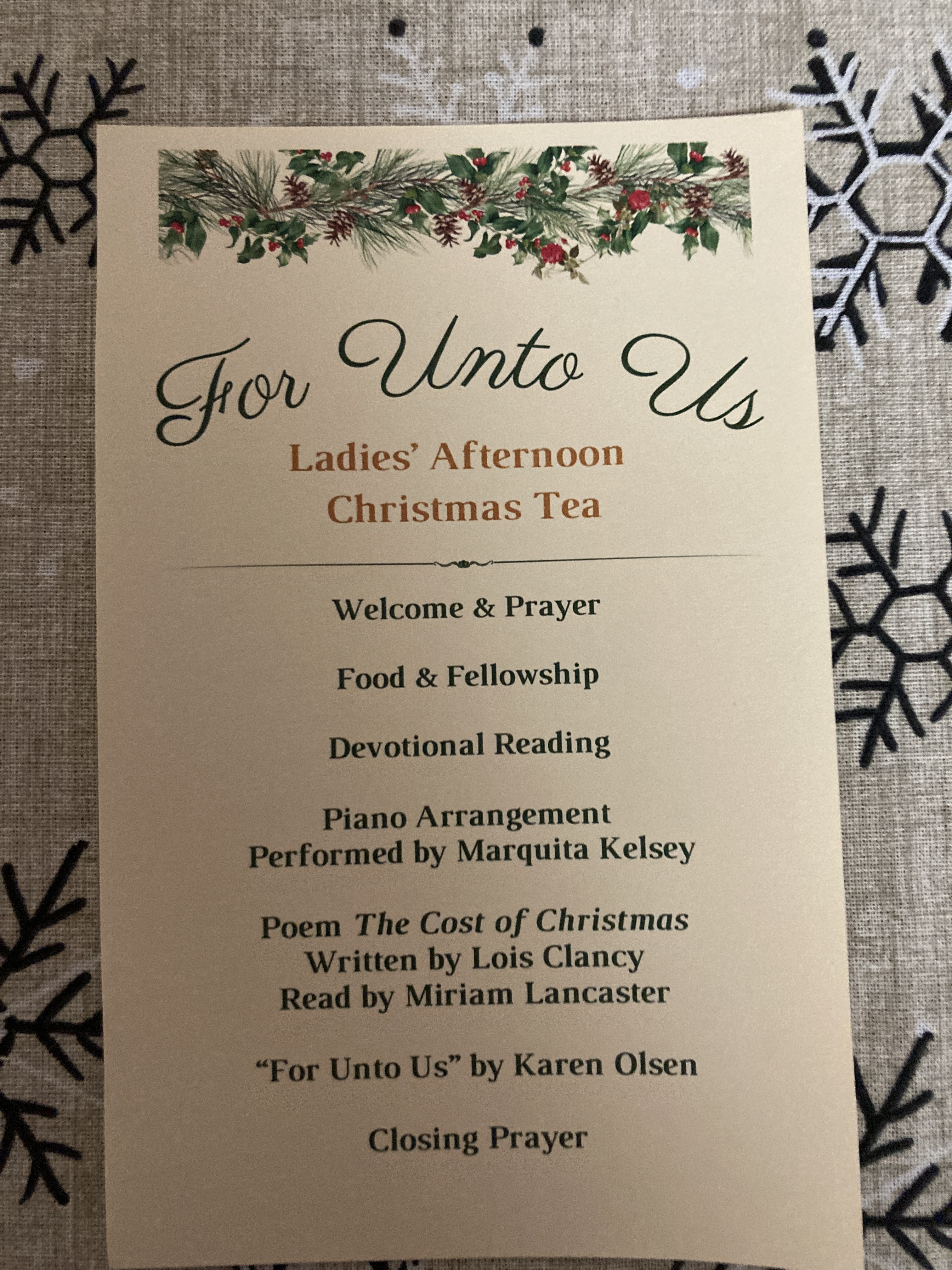
[My opening remark: My mind has been percolating like a boiling tea kettle on and off for weeks now on our theme, “For Unto Us,” so I scripted my thoughts to control their flow.]
For Unto Us
“For Unto Us.” Such a little phrase – “For unto us.” But what does it mean? Biblical literacy and cultural literacy bring context to our theme.
Biblical literacy: immediately we may finish the sentence in our minds: “For unto us a child is born; unto us a son is given.” Thus begins Isaiah 9:6.
Cultural literacy: maybe our minds sing it:
“For unto us a Child is born. Unto us a Son is given….” Maybe our minds continue to sing: “And the government will be upon His shoulders. And His name shall be called Wonderful. Counselor. The mighty God. The everlasting Father. The prince of peace.”
The music is from the oratorio, Messiah, by George Frideric Handel (the German composer who lived most of his adult life in England). Given a libretto, a text to be set to music, consisting entirely of biblical texts, Handel was asked to write music to proclaim these Scriptures. Handel hid himself away in his house in London for 24 days in 1741, composing furiously from morning until night, this new oratorio written for orchestra, choirs, and vocal soloists. He named it simply, Messiah.
What joy we have today to mingle a portion of the biblical text with a bit of the musical context here at our tea party. A tea party drenched in biblical, cultural, and spiritual meaning. A feast for our eyes, our palettes, our minds, and our hearts in the context of sisterly fellowship. What joy. Yes?
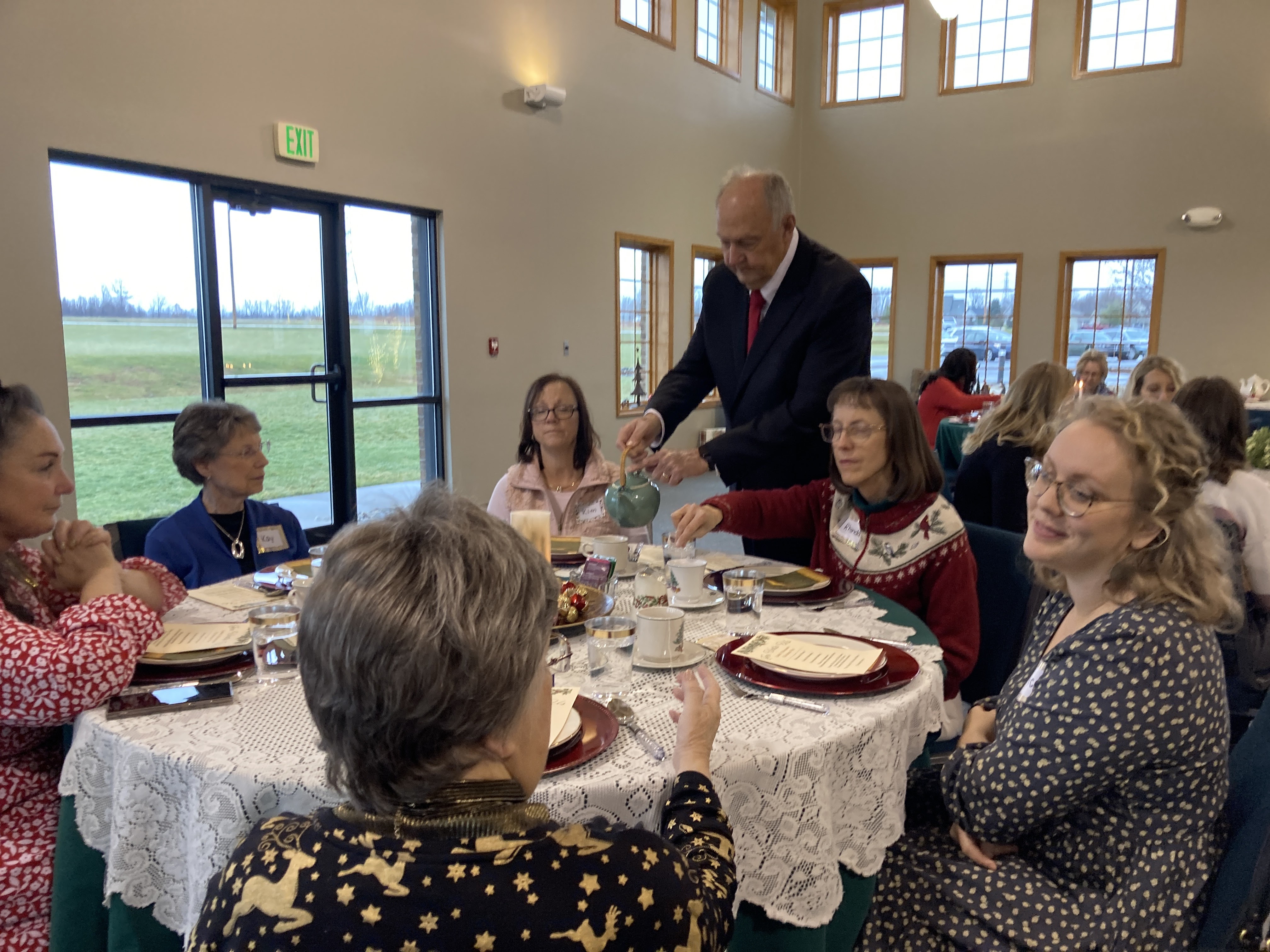
Three handsome gentlemen waited graciously on tables to be sure tea pots were full of hot water and to assist in various ways. (A photo of the other two handsome gentleman is at the end of this post.)
“For Unto Us”. Yet, I’ve been taught, “It’s not about us, not about you, not about me! It’s about God.” But this Bible verse says, “For unto us!” a child is born. Hmm.
I’ve been taught that God is sovereign; Jesus is Lord. We are His servants. Yet, Psalm 28:7 says that God is my helper; He helps me! Jesus said He came to serve. The Scripture explains that He humbled Himself and became like us yet without sin. Actually, Scripture says that He became sin for us. For us.
Luke chapter 2 says that the angels told the shepherds that “there has been born to you– to you– a Savior, who is Christ the Lord.”
Irony. The Lord is born to you? For unto us? What kind of God is this who is the omnipotent, sovereign, governing Lord of the universe and also is the servant of His own servants?
We have to pay careful attention to the ironies of Scripture. These paradoxes must be held in balance creating a tension. This Lord-Master who serves; this servant who is served and saved by her Lord- Master. This Lord of love is the Lord of justice. This God who is one; this one God who is trinity. God does not share His glory with anyone, but He shares His life with us, which is His glory.
A proper understanding of Scripture requires that we pay close attention to the tension presented to us by many coordinating truths. When we do not pay attention and allow one biblical concept to override or shadow another biblical concept, we develop what one biblical scholar calls “Tension Deficit Disorder.” ** A lack of attention to the necessary tension.
So, notice the tension of juxtaposed truths presented to us in our theme verse. “For unto us a child is born, a son is given. And the government will be upon His shoulders. And His name shall be called Wonderful. Counselor. The mighty God. The everlasting Father. The prince of peace.”
The child, the son governs as the mighty God? The child the son, like the Holy Spirit, is the wonderful counselor? The child, the son is equated with the eternal father? The child, the son is the prince of peace.
We hear some ironies, paradoxes, seeming incongruities here. Yes? Yes. This is in the Old Testament. Is the curtain pulled back, previewing a revelation of the trinity in the New Testament?
In the New Testament, Jesus stacks up towers of ironies (which we have no time now to explore), attracting lots of attention (think of the Beatitudes), where we’re tempted to develop “Tension Deficit Disorder”, if we insist on ironing out the ironies, if we insist on reducing God to our understanding and life to our will.
Instead, we need to embrace the tension and appreciate the big, textured, colorful, and multi-dimensional picture God paints of Himself and His ways with us.

The buffet tables were full of savories, scones, and sweets.
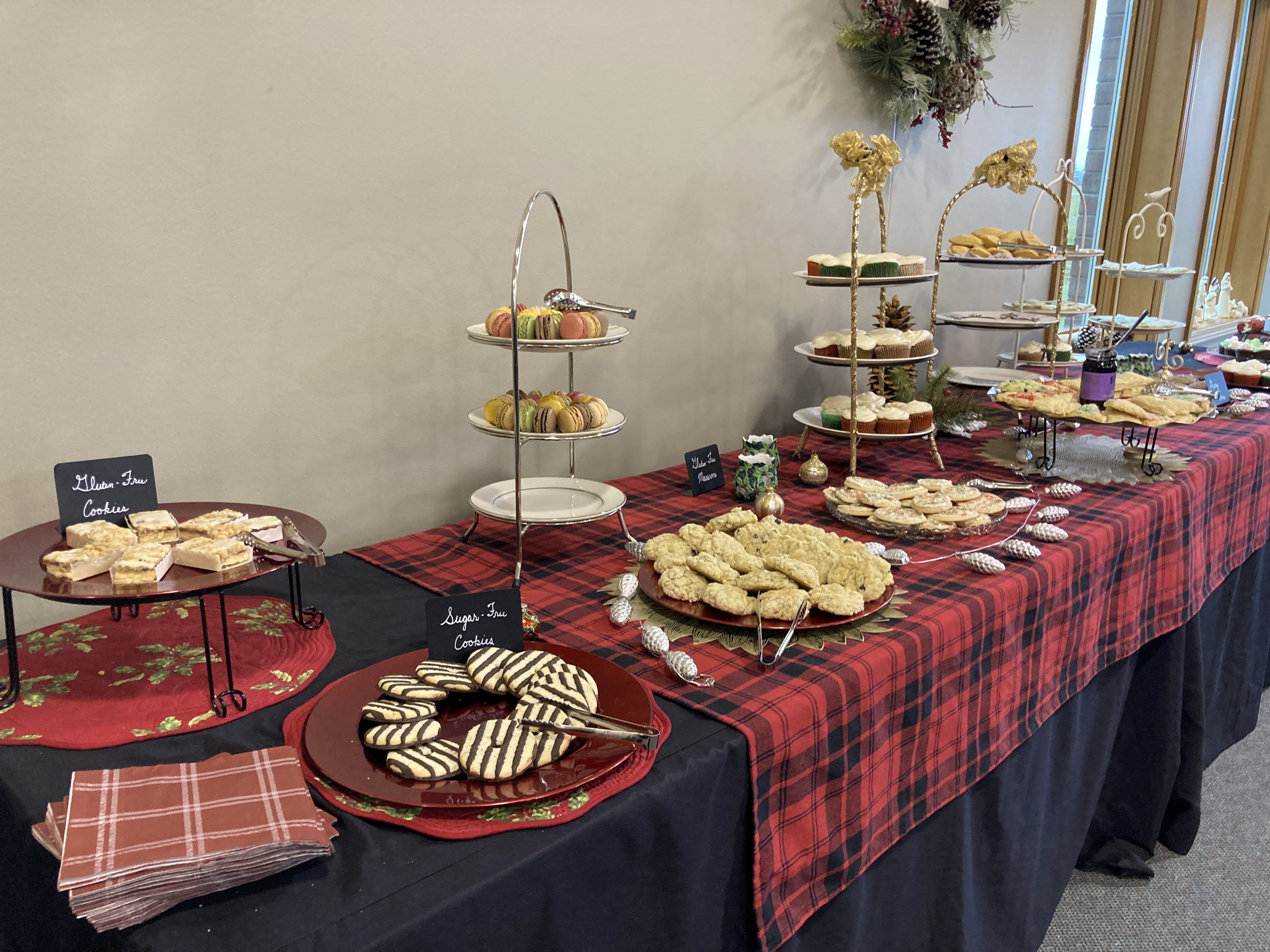
So many choices!
For unto us a son is given; the Sovereign God of the Universe for whom all glory is due, ironically and lovingly chose to serve us, like a servant. Romans 5:8 says, “For while we were yet sinners, Christ died for us,” for us. And what should be our response? “Oh, my! Serve me? I don’t see how I can let you do that! You’re God! I’m I’m….Okay!” Really? Or on the other hand we may think, “God wouldn’t be interested in me! He’s too busy.” Really?
Too busy? It is impossible for God to be too busy. By the nature of His absolute perfections and infinite competencies, God concentrates fully on everything and everyone simultaneously. Drink it in! He is absolute perfection, infinitely competent in all His attributes. No, we’re not okay. No, He is not too busy. Yes, He is fully interested in each of us, simultaneously.
“I love you.” God tells us in John 3:16: “For God so loved the world that He gave His one and only son….” “You are helpless,” God reminds us in Romans 5:8. “I created you,” God tells us in His Word, “I saw you die in Adam. When you were dead in your sins, I and only I am the one who makes you alive together with Christ.”
Yes, we are God’s servants, but not until He is our servant, our Savior. For unto us He came and died for our sins to forgive us. Then He shapes us into His masterpieces – created in Christ Jesus to help others.
Psalm 28: 7 says, “The Lord is my strength and my shield. My heart trusts in Him, and I am helped.”
God is our helper. The Helper gives. Gives what is needed: cleansing, forgiveness, new life, strength for each day. We need to accept His help. Accept it gratefully. That is what He is looking for from each of us, because that is what He knows we need.
The concept of God as helper blesses me also as a woman. In Genesis 2: 18, God said, “It is not good for the man to be alone; I will make him a helper or helpmeet suitable for him.”
The Hebrew word used here for help/helper about the woman is the same word or root word used two dozen times about God in the Psalms alone, as well as elsewhere in the Old Testament. Drink it in!
Women often have felt irritated at being called helpers. It sounds demeaning, second class. We may patronize our children, calling them “our little helpers.”
But being a helper is not second class; it is not a patronizing idea. It is a role of participation and belonging. It is relational, meaningful, and necessary, leading to accomplishments. You don’t need to be married to be a helper. Again, you don’t need to be married to be a helper. All women are helpers in God’s kingdom, and though differently so are men. Created in God’s image, we, male and female, are entrusted stewards, and as such, we are team-working helpers. I love being part of a team. That is what a family is. That is what the Body of Christ is!
Paying attention to the Scriptures that describe God as a helper, meeting human needs, sheds light on my role as a helper. Growing as God’s helper makes me increasingly Christ-like. I encourage each of us ladies to accept this joy.
Psalm 28: 7 begins, “The Lord is my strength and my shield. My heart trusts in Him, and I am helped.” Helped by whom? By the Lord our God who is absolute perfection and infinitely competent in all His attributes.
So, how does Ps. 28:7 conclude? “…Therefore, my heart joys (exults/bubbles over), and with my song, I shall thank or praise Him.”
George Friderc Handel was such a Christian who praised God with God-exalting, bubbling over music, and he served us through his bubbling over, Baroque music.
Handel was a big man with big hands and big feet, a big personality and a big appetite, yet, ironically, he largely ignored the trays of food brought to him daily during those 24 days of enraptured composition of Messiah. His servant found him weeping as he concluded scoring the Hallelujah Chorus. Handel cried out, “I did think I did see all Heaven before me, and the great God Himself!” After completing his 260 page manuscript, he described to a friend his composing experience in words reflective of the Apostle Paul: “Whether I was in the body or out of my body when I wrote it, I know not.”
In three parts, Messiah, tells the prophecy of our Messiah’s first coming, then of his passion, suffering to serve and save us, and finally the prophecy of His coming again in glory.
Hallelujah? Hallelujah!
Our theme today, For Unto Us, is found in part one. For Unto Us. Such a little phrase. “For unto us a son is given”; “for God so loved the world that He gave us His one and only Son that whoever believes in Him shall not perish but shall have everlasting life. ” This season, find an opportunity to listen to and maybe watch part or all of Messiah, in a spirit of praise and worship.
Our Creator God who is absolute perfection and infinitely competent in all His attributes is the loving giver who became the gift. Such paradox. The giver becomes our daily helper.
Gratefully, we ladies as new creations in Christ become God’s helpers (ironically, because He needs no help, yet He has so designed us!).
And with our varied gifts we thank and praise
the Child, the Son,
the Wonderful Counselor,
the Mighty God,
the Everlasting Father
The Prince of Peace.
Why?
For unto Him…
for unto Him…
for unto Him is due all praise.
Amen? Amen!
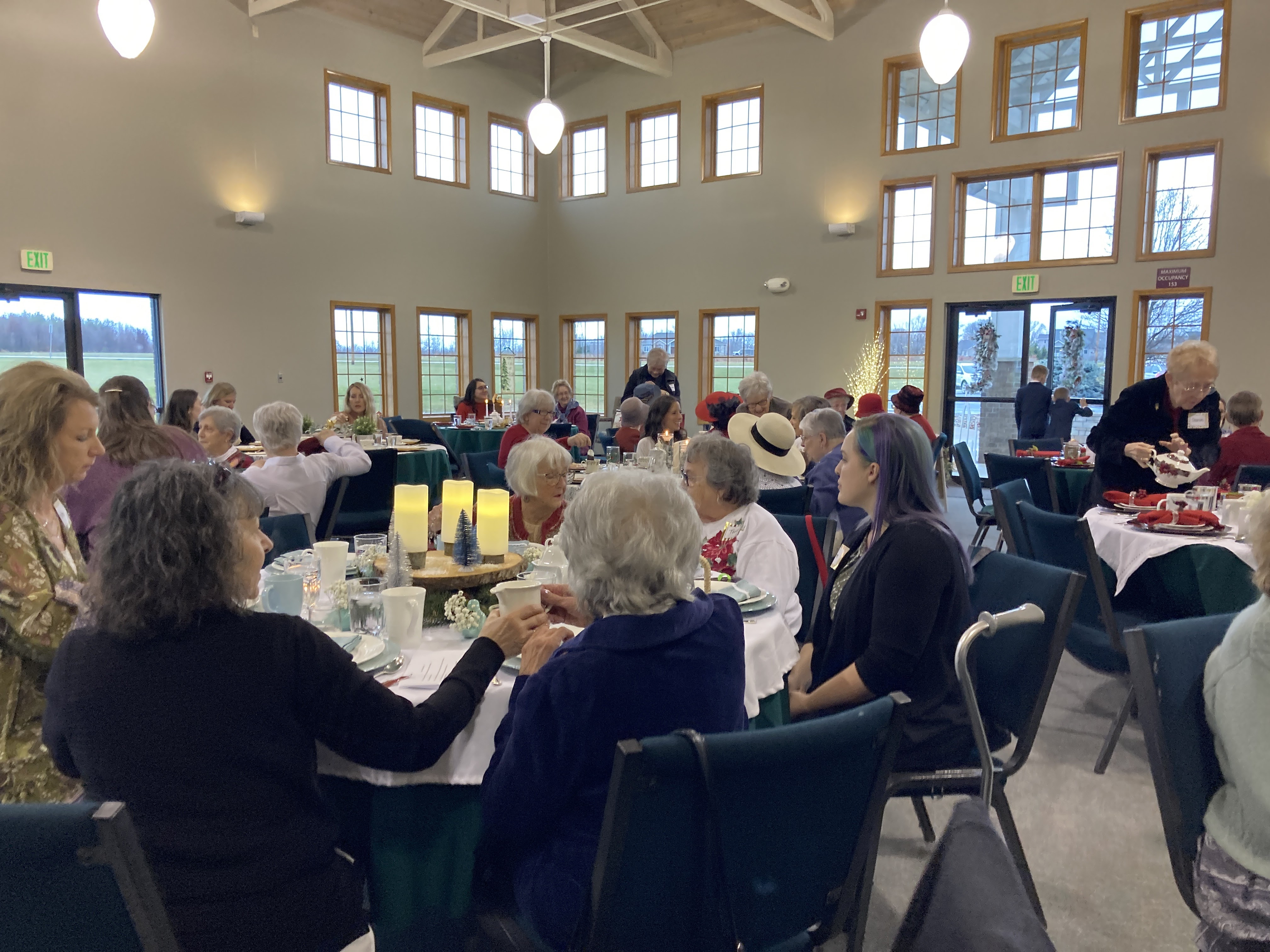
Each table hostess set and decorated her own table. She warmly hostessed her table guests.

Pastor Luke Johnson and my husband, Paul, were two of the handsome table waiters. We could tell that they enjoyed serving the ladies. What godly gentlemen.
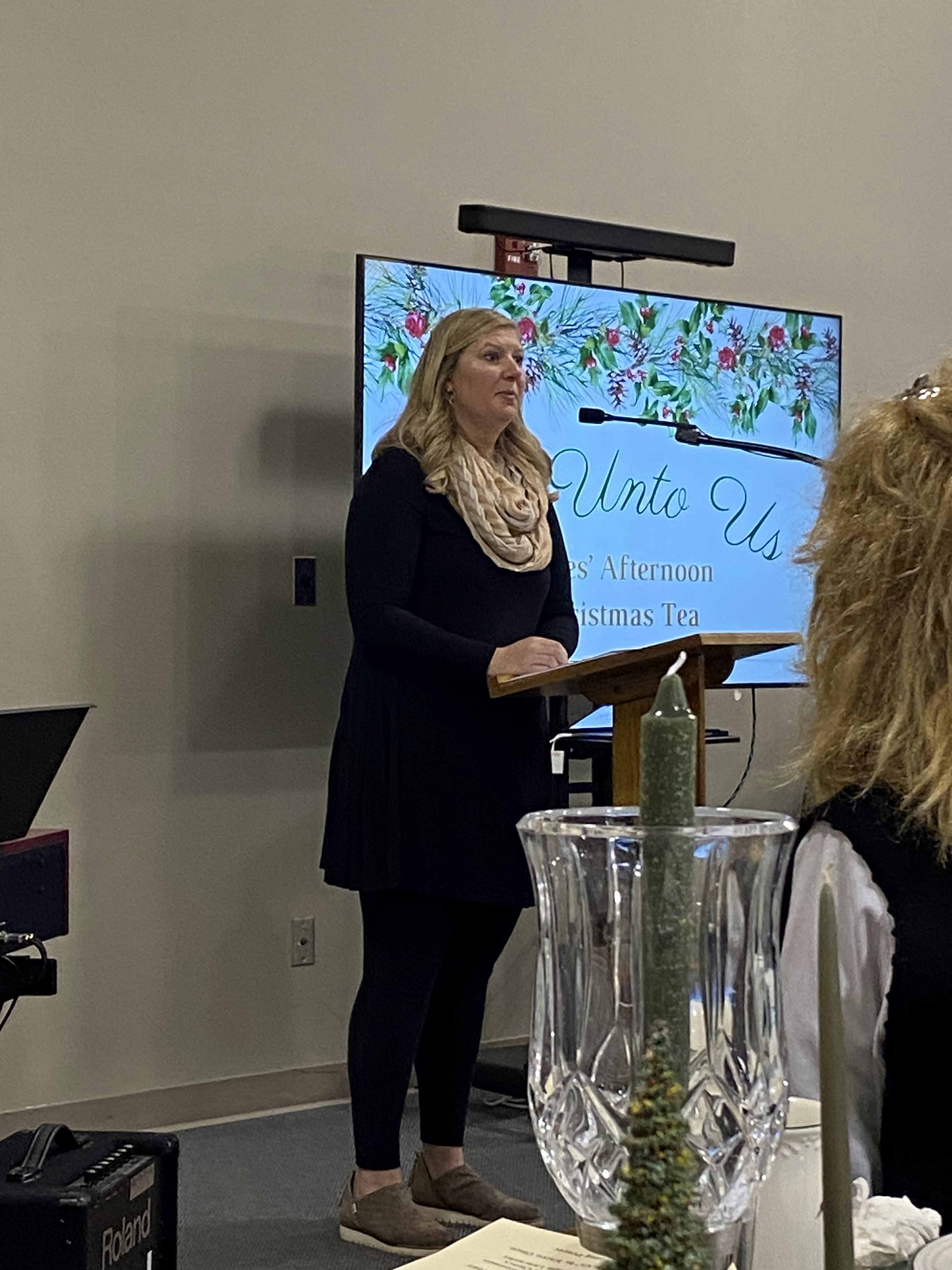
Lisa Johnson (Director of Women’s Ministries and wife of Pastor Luke) was the head organizer and moderator of our Christmas Tea, who worked diligently, as did her team, to serve the ladies of our church and our guests.

Christian love and Christmas joy was visible on the ladies’ faces and in their enthusiastic participation.
After my tea talk or holiday homily and before the closing prayer, we listened to the following performance of “For Unto Us” from Messiah, as performed by the Academy of Ancient Music, at the Chapel of Trinity College, Cambridge, England. This is the full performance, but “For Unto Us.” begins at 27.28 minutes into the performance. Enjoy.
***
*You are welcomed to use this text in your home or with a group as an oral reading. Just give proper attribution.
**Peter Kurowski, The Seduction of Extremes. (St. Louis, MO: Torelion Publishing, 2007), 13-24.
Patrick Kavanaugh, The Spiritual Lives of Great Composers. He is also the author of A Taste for the Classics. A third good choice is The Gift of Music (Great Composers and Their Influence), Jane Stuart Smith & Betty Carlson. These music history and biography books are excellent books for every home library!!
This article was written for oral delivery and could be slightly edited to fit a male and female audience. There were so many points I wanted to develop but could not because of the day’s purpose. I really wanted to expand on the thought that it is impossible for God to be too busy. It draws me back to one of my earliest memories of my father’s preaching. When I was about five years old, I remember Dad preaching a sermon he entitled, “Five Things God Cannot Do”. It so caught my attention that I still remember the title nearly 65 years later! I’d like to do a series on “Things Impossible for God”. Anyway, I pray that this holiday homily presented last Sunday provoked thought, spiritually stirred hearts, and drew ladies closer to Him. If it is ever read or heard again, may God touch readers/hearers, drawing each closer to Him, strengthening faith. May your faith, dear reader, be strengthened, growing in confidence in your Savior who is never too busy for you, and as Emmanuel (God with us) is always near each of us — simultaneously.
Discover more from Journey North Character
Subscribe to get the latest posts sent to your email.


 Journey North Character
Wow, this is so very, very, good – “A tea party drenched in biblical, cultural, and spiritual meaning. A feast for our eyes, our palettes, our minds, and our hearts in the context of sisterly fellowship.”
Thank you for your encouragement!
Karen, I want you to know that God prompted me to integrate several of your truths in my closing prayer at last night’s prayer meeting at our church. One of our elders organized the order of what he entitled: “Welcoming Christ into our World: An Advent Prayer Service. Here’s the service order: Worship; Teaching on Prayer; Prayer of Lament/Confession; Prayer for Israel, Palestine, and the World; Prayer for Community; Personal Prayer Requests (gathered from congregants during the morning service); Present Needs (those attending the prayer service, including anointing with oil for healing); Worship; Closing Blessing. My prayer acknowledged God’s not wanting to give His glory to another (Is.42:8) yet thanking Him for giving His life to us in the prayer meeting “which is His glory.” (Your words) I thank God for being our helper and Jesus for becoming sin for us. I closed with a sense of wonder that the child who was born was a son that was given . . . for unto us. Thank you, Karen, for another masterpiece of theological meditation (spiritual food for thought and application). Know that the Spirit used your words to impact another 50 people in California through me.
Thank you, Martin, for this encouragement. I am trying to pass on my batons, so I am thankful for any usage of anything biblically sound and enriching that you extract from my words. Thank You, Lord.