Government

The G. of G. # 5: Praying for Our Nation

This will be a shorter post, and I’l continue the theme in the next post (hopefully, next week).

This election week has left us with much angst, but as Christ-followers, we need to keep preaching the Word to ourselves (listening to the Holy Spirit, our teacher). We are citizens of two kingdoms, and we view this temporal citizenship through the lens of our eternal citizenship. Thus, we pray: “Thy kingdom come. Thy will be done on earth as it is in heaven.”

Paul and I have participated in several group prayer meetings this week. With anxiety I entered the second prayer session and impressively experienced the very claims of the Scripture being discussed:

“Do not be anxious about anything,

but in every situation, by prayer and petition, with thanksgiving,

present your requests to God.  

And the peace of God, which transcends all understanding,

will guard your hearts and your minds in Christ Jesus.”

Philippians 4:6-7 (NIV).

We were encouraged to pray. That is our part. We were encouraged to trust God’s sovereignty. His rule is His part. He is good and faithful, wise and true. And as we prayed, I felt the angst and anxiety drain out of my heart, mind, and bones. The weight lifted, and I smiled in faith.

We were encouraged not to feed our spirits with news and social media and such. Instead we were encouraged to drink in Scriptures, listen to worship music, and praise God.  After the prayer session, I sat at our piano and played beautiful hymns, drinking in the Bible-drenched lyrics. Thank You, Lord! I trust in You and Your Sovereign working of Your wise will for today and every tomorrow.

Below are some Scriptures to encourage you:

Continue reading

Categories: Government, prayer | Tags: , | 2 Comments

The G. of G. #4: In God We Trust

Are you familiar with how the motto, “In God We Trust,” came to be placed on our coins and bills? It’s interesting. Often times, it seems that conflict is necessary for humans to be humbled and to face their need. I’m sure that each of us can personally concur.

I’ll get to a short version of that story. But first, I want to ask you this. Did you read any of the four Christian worldview articles that I listed in my previous post? If not, I’d encourage you to check out this site: https://prayvotestand.org/worldview!

These worldview articles will not only help you to see biblical principles that impact social issues and public policy, but they will also give you good examples of how to build biblical perspectives on issues and show you how to improve the biblical shape of your own worldview. A Christian worldview is not static. No matter how old I am,  I’m finding that I can continually grow toward a more sound view and practice.

This is the fourth article in a series entitled The Grammar of Government.*1  I plan to write one or two more articles in this series before moving on to another theme.

Have you re-read The Constitution of the United States recently? The Declaration of Independence? Our Constitution and the Bill of Rights are often studied in conjunction with The Declaration of Independence and compared with colonial charters and constitutions, and colonial self-governing perspectives and practices. Fascinating.

Have you noticed that the Constitution of the United States never references God?

Continue reading

Categories: Biography, Christian Reader, Government | Tags: , , , , | Leave a comment

The G. of G. #3: How Do You Build a Biblical Worldview to Apply to Politics?

Over two weeks have passed since I posted my last article in this series, The Grammar of Government. Since then, the trees have broken out in vibrant colors. Paul and I spent four days camping with two dear friends in Pokagon State Park along Lake James, just 40 minutes north of our home here in Indiana. And politics rolls on.

Our president has encountered COVID19, fought the battle with impressive medical assistance and through God’s grace, and now he seems to be even more energetic. A fascinating and helpful Vice Presidential candidate debate occurred. A Presidential candidate debate was cancelled. Political town halls and rallies are happening.  The Senate this week has held hearings to scrutinize Amy Coney Barrett (currently a circuit court judge for the seventh circuit of the US Court of Appeals, who was chosen by President Trump to fill the Supreme Court seat left open by the death of Ruth Bader Ginsburg). Senators bloviated. Barrett articulated. Delightfully or begrudgingly, the audience recognized in ACB refined, humble, well-rounded greatness.

How do Christians build a biblical worldview and apply it to civic and political involvement in our Constitutional Republic? In this post, rather than my writing my views, I want to pass on to you a number of articles and a resource that you can explore online to assist you in this pursuit.

I hope that these will encourage you in your personal prayer, research, and decision-making on behalf of our country. You may want to mark these sites to come back to them as you can. Continue reading

Categories: Government, Perspectives on Culture, Theology | Tags: , , | Leave a comment

The G. of G.#2: What is the Relationship between Self Government and Civil Government?

This is part two in my series on The Grammar of Government. (If you did not read the first article, run back to my previous post.)

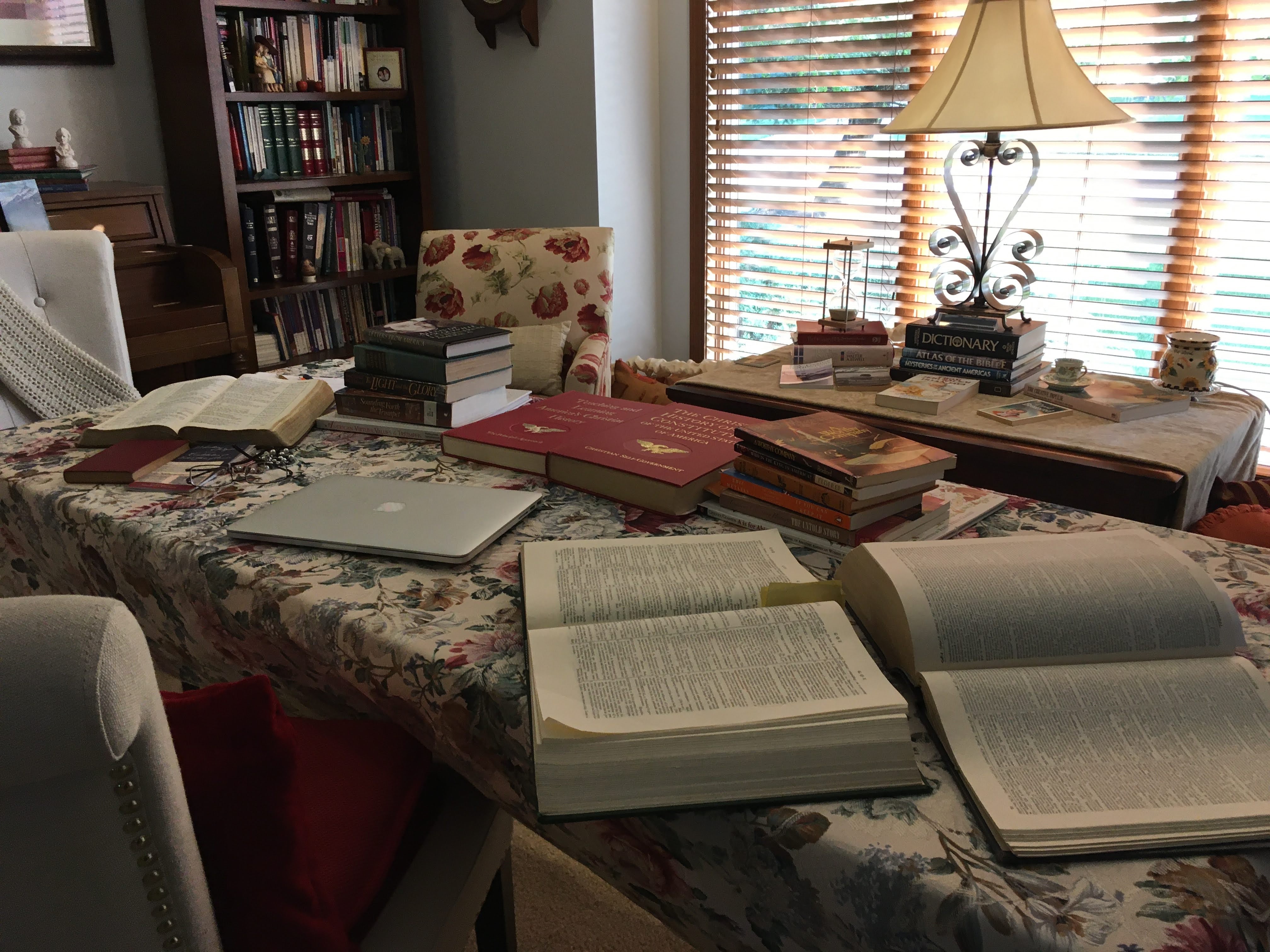
My study table for this series, set up in our living room in the front of the house. (I study all over the house, but usually in our sunroom in the back of the house.) I’ve been studying and simmering….

Why am I writing this series? Why would I bother to read, re-read, and study all this material in order to condense a few, good thoughts on the topic of government?

Two students of our history said it best many years ago:

“But the blessings of liberty in America cannot be perpetuated unless the principles of that liberty are re-identified and re-affirmed in each generation.”*1

My answer is because it is needed. The situation in American is now so confusing and muddled, that only by going back to the basics or “first principles” can we see our way through the maze in order to make better decisions and affirm liberty for ourselves, so that we have it to pass on.

Continue reading

Categories: Government | Tags: , , , | Leave a comment

The Grammar of Government: Part 1

Grammar. Government. How do you respond when I say each of these words?

Many, so it seems, feel irritation, disdain, or boredom at the word, grammar. Some are intimidated at the thought of grammar. As a school subject, grammar is typically disliked. I know. I was an English teacher. Most students that entered my classroom were there only because they had to be. I understand. Yet, there were a few, besides me, who were fascinated by studying the workings of language.

Government, particularly these days, is a word that conjures up even more distasteful feelings. So, why would I put the two together? “The Grammar of Government” is not a title that would attract readers. Admittedly, true. How unfortunate. But I’ve done it anyway, and you are reading this! Let’s see if I can keep your interest. (And if not, “A good day to you!” and “God bless you!”)

Now, really, grammar is very exciting! And government…well, it is an overwhelming topic, but also, oh, so exciting (and intimidating and frightening and dangerous and demanding and so on).

You may only think of “grammar” as “the parts of speech,” um, “How many?” In English we employ and study the eight parts of speech. We observe how words shape phrases and clauses, and how they are structured into paragraphs and whole works of every genre.

Well, actually, grammar is more basic, and every field of exploration (discipline, hobby, or career) has its own grammar. Simply defined, grammar means “the fundamental principles or rules of an art or science.”*1 The rules of chess form the game’s grammar. The grammar governs the game.

We are in an important time to consider the grammar of government. Most likely, you are thinking of politics. Election day is near. Also, today, September 17, is Constitution Day, which commemorates the writing and signing of the U.S. Constitution on September 17, 1787.

However, as we pursue the grammar of government, politics is not the place to start. Then where do we start?

Continue reading

Categories: Government | Tags: , , | 2 Comments

Blog at WordPress.com.