
“Time like an ever rolling stream bears all its sons away,” wrote the Englishman, Isaac Watts, in 1719. (1)
We feel the rolling of the years, personally and collectively. Every voice of wisdom (and folly) is borne away, leaving behind echoes, fingerprints, footprints, and pathways. We follow in the wake, debating the best winding trail to take.
In various ways we Americans are celebrating our country’s 250th birthday this year. In our home library we have a section of books on American history. I also have a set of classics that I inherited from my father published for the Classics Club back in the 1940s. Pulling off the shelves a set of books, I have beside me three classics from the series: William Bradford’s History of Plymouth (Of Plymouth Colony), Benjamin Franklin’s Autobiography, and Plato’s Five Great Dialogues.
Why did I include Plato in my stack? Russell Kirk explains in his great, modern classic, The Roots of American Order, first published in 1974.(2)
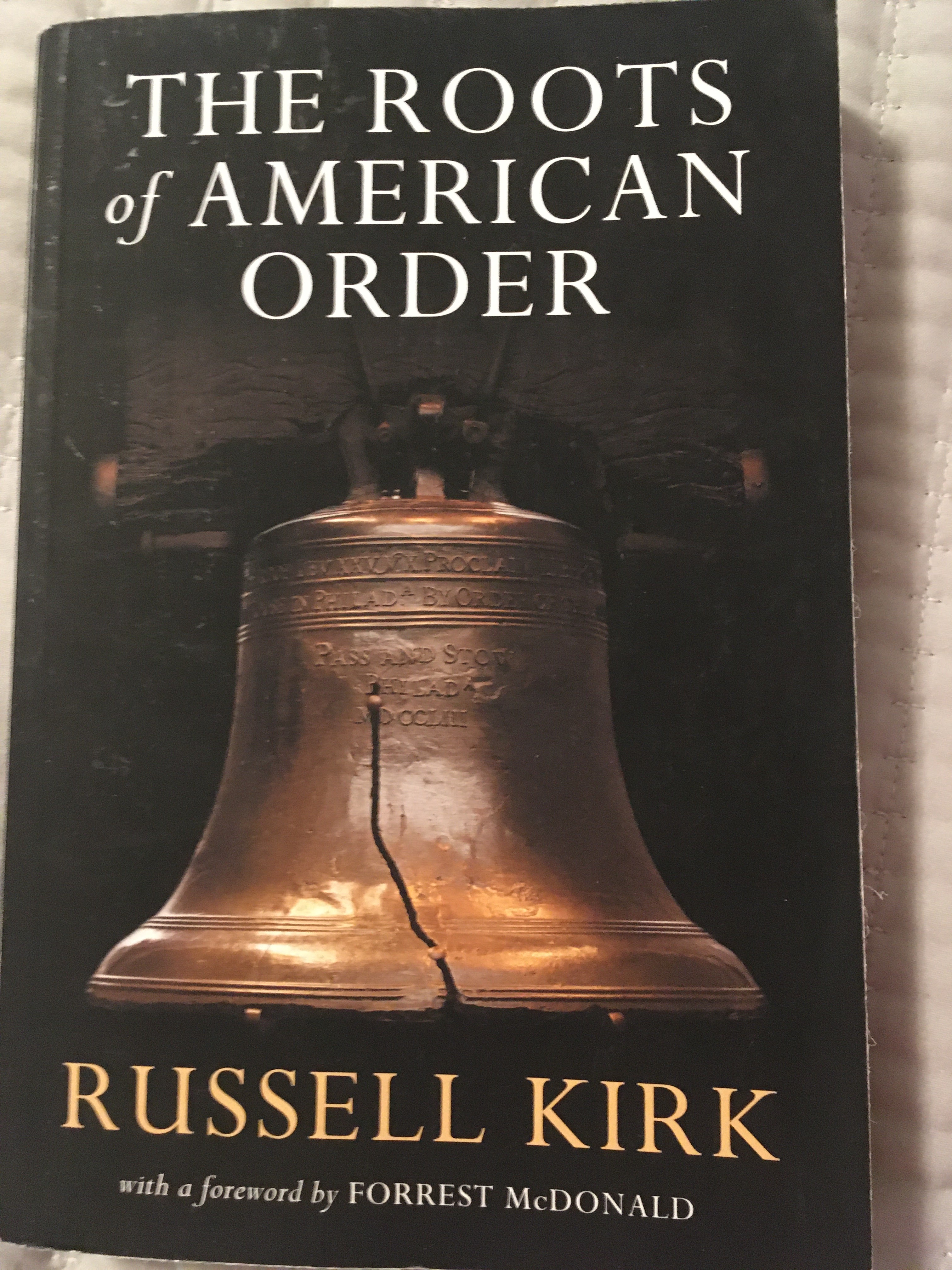
Worth reading.
Kirk traces our roots to four great representative cities: Jerusalem, Athens, Rome, and London. While Jerusalem represents America’s nourishment from Moses and the Hebrews, Athens represents the legacy from Greece, thus Plato. Add to these Rome’s lessons first as a republic before becoming an empire, and then London’s legacy from the days of the Magna Carta. These sturdy roots deepen the indelible marks of human striving for order. Kirk explains that “the ‘inner order of the soul’ and the ‘outer order’ of society [are] intimately linked.” (3). Do you hear the underlying heartbeat of the idea of self-government?
To better understand the roots of America as an “idea” (versus an ethnicity or mere region), Kirk shows the basis of America lies in its presuppositional perspectives on order. I resonate with this deeply since my only published book, A Traveler’s Guide through Suffering and Joy, is shaped by “order,” that is “cosmos.” Cosmos means order: how things work and are governed, so that we can come to terms with reality. We need our feet planted on the firm foundation of what is true; this is “order” or “cosmos.” Order precedes us. Order humbles us and frees us. It can simplify our lives by revealing what is truly important. The rest (internal and external disorder) is anxiety-churning chatter.
To enhance our 250th birthday celebration, I offer you some American thoughts to feed your soul. No chatter. Just slow-releasing nutrition.
“America has always been more than a place on a map. It is an idea — a daring declaration by our Founders that ‘We the People’ could govern ourselves, worship freely, speak boldly, and live without fear of tyranny.” A recent letter from ACLJ (American Center for Law & Justice).
“The Eyes of all our Countrymen are now upon us, and we shall have their blessings, and praises, if happily we are the instruments of saving them from the Tyranny mediated against them. Let us therefore animate and encourage each other, and shew the whole world, that a Freeman contending for liberty on his own ground is superior to any slavish mercenary on earth.” George Washington: “General Orders” July 2, 1776.
“It is the will of heaven that the two countries should be sundered forever. It may be the will of heaven that America shall suffer calamities still more wasting and distresses yet more dreadful. If this is to be the case, it will have this good effect, at least: it will inspire us with many virtues which we have not, and correct many efforts, follies, and vices, which threaten to disturb, dishonor and destroy us…. The furnace of affliction produces refinements in states, as well as individuals.” John Adams in a letter to his wife, Abigail on July 3, 1776.
“We must all hang together, or assuredly we shall all hang separately.” Benjamin Franklin reportedly remarked on July 4, 1776.
” When in the Course of human events, it becomes necessary for one people to dissolve the political bands which have connected them with another, and to assume among the powers of the earth, the separate and equal station to which the Laws of Nature and of Nature’s God entitle them, a decent respect to the opinions of mankind requires that they should declare the causes which impel them to the separation.” So begins The Declaration of Independence, adopted by the Second Continental Congress on July 4, 1776.

I observe here the recognition that “the course of human events” is ensconced within or dependent upon “the laws of nature and nature’s God” (capitalization rules, as well as spelling and punctuation rules of that period differ from current usage). “Nature’s God” is the first of four references to deity.
“We hold these truths to be self-evident, that all men are created equal, that they are endowed by their Creator with certain unalienable Rights, that among these are Life, Liberty and the pursuit of Happiness,” so famously continues The Declaration of Independence.
Here we have the second of the four references to God in this document which was first drafted by Thomas Jefferson over the course of less than three weeks in June of 1776 as a part of a team assigned to the task of articulating the controversial and highly debated decision, including a list of causes or justifications for this ultimate separation from British rule.
After submitting “to a candid world” “a long train of abuses and usurpations” (27 grievances), “pursuing invariably the same Object”– “absolute Despotism,” the document concludes with an appeal to “the Supreme Judge of the world” while claiming “a firm reliance on the protection of divine Providence.” Now we’ve located the third and fourth references to God. God as the Supreme Judge and God as the Providential Protector. With such force of confidence in ultimate “order” beyond the power of human ability, our founders proceeded to carve a fresh highway in the annals of history.
“No people can be bound to acknowledge and adore the Invisible Hand which conducts the affairs of men more than those of the United States. Every step by which they have advanced to the character of an independent nation seems to have been distinguished by some token of providential agency.” George Washington on April 30, 1789 in his first inaugural address.
Our first president so logically and comfortably recommends that we gratefully adore our Lord, whose invisible hand providentially cares for us. What encouragement!
“The care of human life and happiness, and not their destruction, is the first and only legitimate object of good government.” Thomas Jefferson in a letter written on March 31, 1809.
These samples provide rich nourishment from our country’s Founders who risked all they had and were for their posterity, us. “We the People.” Our many Founders drew upon the heritage of past civilizations: the Hebrews, the Greeks, The Romans, and the English in search of divinely offered wisdom. They were attentive to the order of reality: God is involved in human affairs; humanity is to be admired as divinely designed, yet fallen and flawed, thus cautiously treated as not to be trusted with weighty power. Every generation needs shaping in virtue, through morality, religion, good habits, and industry. Self-government underpins civil government.
Our heritage offers us inspiration, direction, and correction. I’d prefer to close with Washington’s beautiful expectation that we Americans “acknowledge and adore” God’s invisible Hand, but I feel a need to not conclude without including Ronald Reagan’s warning:
“Without God there is no virtue because there is no prompting of the conscience… without God there is a coarsening of the society; without God democracy will not and cannot long endure…. If we ever forget that we are One Nation Under God, then we will be a Nation gone under.” Ronald Reagan on August 23, 1984.
Since this is true, let’s re-read and ponder Washington’s inspiring admonition:
“No people can be bound to acknowledge and adore the Invisible Hand which conducts the affairs of men more than those of the United States. Every step by which they have advanced to the character of an independent nation seems to have been distinguished by some token of providential agency.”
May such providential agency be God’s Merciful Hand moving continuously to re-direct, nourish, and protect us.
A Blessed, Satisfying, and Grateful July 4th to you all.
Check out a previous post I wrote about Kirk and this book: https://journeynorthcharacter.com/2022/05/06/back-to-kirk-the-roaming-reader-3/#more-4829
Challenge: take some time on July 4th or thereabouts to re-read The Declaration of Independence. Read it aloud in a group, multiple people taking turns reading. Divide it into several reading sessions, if helpful. I think you’ll discover a greater impact by reading it aloud with others.
1.From Isaac Watt’s hymn text, “Our God, Our Help in Ages Past.”
2. Russell Kirk. The Roots of American Order. From the Fourth Edition, 2003 and sixth printing, 2017. By the way, I’m sorry that I did not quote in this post from any of the three Classics Club books I mentioned! Maybe another time. Maybe not!
3. Ibid., 6. Check out a previous post I wrote about Kirk and this book (from which you can find maybe two other posts in which I wrote about this book or Russell Kirk):
Discover more from Journey North Character
Subscribe to get the latest posts sent to your email.




Wonderful quotes as we soon celebrate the country’s 250th birthday! Best Independence Day wishes to you and your family!